Come Ye Blessed...
BUNNY
CHURCH OF ST MARY THE VIRGIN
Church Post Code NG11 6QW
Church normally closed to visitors. Open on English Heritage Ride and Stride Day.
There were two Vale of Belvoir Angel stones recorded here by the Heathcote's. Against each there is a note saying that the stone had been laid flat. That visit was in the mid 1970's and now the vast majority of the stones here are laid flat and are gradually being swallowed up by the grounds. I found one okay but double checked the grounds and couldn't find the other, which may have been fully covered by the grass.

Gradually being swallowed by the encroaching grass this Belvoir Angel stone lies flat, the sad looking angel taking the chance to look out before it gets fully covered.
This one reads 'Here lies interr'd the body of Henty Hebb who departed this life in the 59th year of his age August 27th 1718'
'Tho death has parted you and I and our bodys to dust must turn I hope yt (that) we shall meet again you have no cause to mourn dear friends do not lament for me but cheer up now your hearts and strive yt you may come to me where we no more shall part Memento Mori'
SOME NOTES FROM MY VISIT
After thinking about it long and hard I have concluded that Bunny is my favourite village name of places visited, narrowly beating Ponsonby in Cumbria. Barney in Norfolk is another favourite, as is Bolton Percy in Yorkshire. Of course that situation will change if I ever visit Wetwang in the Yorkshire Wolds!
It was the second weekend in September and we had headed out to visit the Hickling Scarecrow Festival. It was also English Heritage Ride and Stride day with many churches open that would otherwise normally be closed out of service times.
The plan for the day was to see the scarecrows; visit half a dozen churches in the area and then finish with a football match at Keyworth where the home side were due host Beeston in the Nottinghamshire Senior League.
We had headed west from Hickling with the church of St Mary at Bunny, which can be found in the Rushcliffe borough of Nottinghamshire being the second of six churches visited, with all being open. The centre of Nottingham can be found some eight miles off to the North West; Melton Mowbray is 15 miles away to the south east. Plane spotters would have enjoyed the day with a constant stream of aircraft heading to and from East Midlands Airport, a few miles away to the west.


The population of Bunny at the time of the census of 2021 was 715. When researching this’ the AI Overview also helpfully stated that the domestic rabbit population of the United Kingdom is currently around 1.1 million with Australia having a wild rabbit population of around 200 million; perhaps searching ‘Population of Bunny’ could have been worded differently!
There was a church and a priest recorded here at the time of the Domesday Survey in 1086, in land owned by Ralph son of Hubert. There has been a settlement here since pre Norman times and possibly back to Roman times with much excavated from that period in the area. With the exception of the church, the most notable building in the village is Bunny Hall which was built originally by Richard Parkyns in the late 1500’s; the structure being rebuilt in 1720.
We will talk more of Sir Thomas Parkyns, 2nd Baronet later, as there is a memorial to him inside the church. Suffice for now to say that he must go down as being one of the most flamboyant characters that I have come across. Known as the ‘Wrestling Baronet’ he was a keen wrestler who organised an annual wrestling event in the village. He wrestled himself; his speciality being a type known as ‘Cornish Hug’ and also wrote books on the subject, including ‘The General Rules of English Wrestling’ which was published in its fullest version in 1727.
This was a revisit; having first visited here back in the spring of 2021. The country was still struggling with covid at that time; churches were allowed to be open but in practice few were and the church of St Mary was closed on the day and I believe that it is normally closed out of service times. The church of St Mary can be found central in the village, in a kind of island; the church and its spacious grounds surrounded on all sides by roads. The village hall adjoins the church grounds at its north easterly edge with Bunny Hall off to the west.
The church was open for Ride and Stride day with a helpful steward on duty. The weather had closed in when I had arrived and it was raining lightly. For that reason I have used exterior shots from the original visit; which was on a gloriously sunny day, with interior shots from the revisit; hence interior shots are a little darker than you would expect given the bright sunshine!


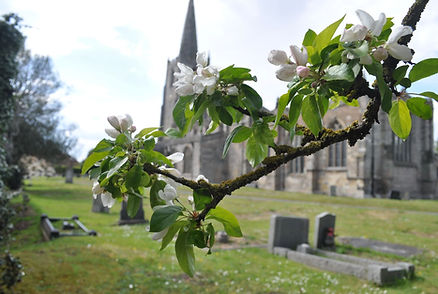
Looking at the exterior for the first time on that initial visit the thought was that this is a magnificent church that reflects the wealth and prestige that was here at the time of building. As mentioned earlier there was a church here at the time of the Domesday Survey but the church that we see today dates back to the 14th century; built around the time that the Black Death ravaged the country.
The church that we see today consists of west tower with spire, nave with north and south aisles and clerestories, south porch and chancel. Due to its impressive size and structure it is referred to as the cathedral of the Wolds.
The church here was originally constructed for Lenton Priory and was appropriated in the mid 1320’s by the Chapter at Southwell to be a chantry for William the Archbishop of York. In 1346 the church here was claimed by Ulverscroft Priory and rebuilding work was started with the tower and chancel each dating from this time; with the latter being of great size and nearly as long as the nave. Work was halted on the rebuilding during the Black Death, which ravaged the country in 1348 and 1349 and it is noticeable that the squared stone of tower and chancel is different to the rubble used on the rest of the structure; indicating the pre and post Black Death phases of building. The medieval church was completed with the walls raised and clerestory added and the south porch built during the 15th century.
Restoration work was financed by Thomas Parkyn in 1718, at which time the chancel and nave were reroofed with the chancel roof being lowered. Further restoration came about in 1887 with this being concerned with the interior; with the old pews taken out and replaced with chairs and a western gallery being removed. At this point as well a fireplace and chimney were removed from the Hall Pew; this being the private pew that belonged to Bunny Hall which ran along the north wall of the chancel.
Just to repeat, the church here comes from different periods; the nave and aisles are pre Black Death and made of dressed rubble. The west tower, chancel and south porch are post Black Death and are made with hewn stone.
Looking at the church from the south, the impressive single stage west tower dominates; buttressed, battlemented and pinnacled with tall slender octagonal crocketed broach spire rising up. The church clock faces out from all sides.
An ancient looking frieze can be seen running across the top of the aisle and clerestory; much patched in places, with these each being of a repeated quatrefoil design with a different design on each. A part of the frieze is also incorporated in to the south porch.
The clerestory takes the form of four two light square headed windows; a small recess above the doorway in the south porch would have held a statue, I daresay of St Mary after who the church is dedicated, prior to the Reformation.
Looking at the chancel there is a bricked up archway, tall and slender, with bricked up doorway within at the western end of the south chancel wall. The east window is interesting with the upper stages looking to have been removed at the time that the chancel roof was lowered. It is safe to say that the pinnacles throughout are in various stages of distress.


There are six bells in the ring here, with five of them being ancient and of great interest. The first two of the ring are each dated 1702; being cast by William Noone of Nottingham. The first of the ring notes that this bell was donated by Thomas Parkyns Second Baronet. The second has the Latin inscription which reads ‘DEDIS NOS CANTARE DOMINO NOVVM CANTICVM 1702’ which translates as ‘You gave us to sing a new song to the Lord’.
The third was cast by George I Oldfield of Nottingham and has the inscription ‘I sweetly tolling men do call to taste on meats that feeds the soole’; with this bell being cast in 1629.
The fourth of the ring was cast by Henry II Oldfied of Nottingham in 1599. This bell has the Latin inscription ‘In noe ihu xpi ome genu flectat celestiu trestm iustorum’ which according to AI Overview is a slight misspelling of ‘At the name of Jesus every knee should bow Of things in Heaven and things on earth and things under the earth’. I would say as well that my spell checker absolutely hated the Latin on this one and is now recovering in a dark room with a gin and tonic!
The fifth is the only bell that was cast out of the immediate area, cast by Thomas Eayre of Kettering in 1740. This one is inscribed ‘PUBLICA SORS PONS WESTMONASTERENSIS PIETA THOMAE PARKYNS BAR: LOQUI DEDIT ORE ROTUNDO A:D:1740’ This translates as ‘A public lottery for Westminster Bridge and the piety of Thomas Parkyns Baronet gave this bell to speak with a round voice’. It suggests that Parkyns purchased the bell here with winnings from the Westminster Bridge Lottery which was held in the years before the building of the first Westminster Bridge, which was constructed between 1739 and 1750; the lottery helping to raise funds for its construction.
The sixth was originally cast by the Mellours foundry of Nottingham. This would have been an ancient bell with Richard Mellours operating between 1470 and 1507 and Robert Picking up at that time until 1525. This bell was inscribed ‘HEC CAMPANA SACRA FIAT TRINITATE BEATA’ and was recast by Taylor of Loughborough in 1955.
It had turned in to a dull and miserable afternoon on this September revisit with a little light rain falling. The wind had increased and we did wonder if the football later on that afternoon was a good idea. Moving inside, the lights were on and after spending a pleasant few minutes chatting to the steward it was time to explore the interior,


The 14th century north and south aisles are each of five bays, with circular piers, apart from those at the westerns ends, which are octagonal. Nave is separated from chancel by an oak screen. A further screen can be seen under the tower arch. Three funerary hatchments can be seen over the chancel arch to members of the Parkyns and Forteath families; the latter being the Lords of the Manor after the Parkyns.
There are wooden chairs in the neve, which to be honest didn’t look all that comfortable, with the old pews being taken out during the late Victorian restoration.
Moving in to the chancel, this is very long; as mentioned earlier being almost as long as the nave. Why it was built like this I dare say reflects the prestige of the church and the wealth of the area at the time of the 14th century rebuilding; having said that though, the proportions are still curious!
Choir stalls line the walls; the high altar is plain with just a couple of candlesticks, the altar being properly furnished on service days. The altar cloth is green, this being the liturgical colour used to mark ‘Ordinary Time’, this being the time in the church calendar between the major Christian festivals. In this case it marks the period between Pentecost, which officially ends the Easter period, and the start of Advent.
At the east end of the south wall of the nave is one of two stained glass windows at this church. This is a three light window with Mary and the infant Jesus central. This is flanked to our left by what I think is St Anna, the mother of Mary. Identification here was not helped by unreadable italic script and Elizabeth the mother of John the Baptist. Smaller panels below show Mary meeting Elizabeth when each was with child; this flanked by depictions of Simeon, to who Jesus was presented in the Temple, and Zacharias the father of John the Baptist.


The high altar is flanked by memorials to the Parkyns family and there are further memorials against the north wall. A wall monument to Richard Parkyns who died in 1603 and his wife Elizabeth catches the eye. They kneel facing each other, with hands raised in prayer. They are flanked by their children, four girls alongside their mother and four sons alongside their father. They face to the south, towards the onlooker, with hands raised in prayer.
Close by is a monument to Dame Anne Parkyns who died in 1725 at the advanced age of 92 years. What times she would have lived through; being a child when the English Civil War started. She would have lived through the time that the country was ruled as a republic before Charles II reclaimed the throne. She would have been in her thirties when the country was ravaged by the Bubonic Plague and no doubt heard stories circulating about the Great Fire of London.
At the foot of her monument we see three angels which were used as a symbol of the safe escorting of the soul towards Heaven after death and two skulls which were and are a memento mori symbol reminding the onlooker that Man is mortal and will die. She had five children, with one of her sons being Thomas Parkyns, the wrestling Baronet.
A close look at the top of this monument shows a female figure, which I assume is an effigy of the deceased; this is flanked by a design of an hourglass circled by a serpent with a tail in its mouth. The hourglass is another memento mori symbol to denote the passing of time and the fragility of human life. The serpent is an ouroboros, an often used symbol to represent eternity.


Monument to Richard Parkyns d 1603 and wife Elizabeth
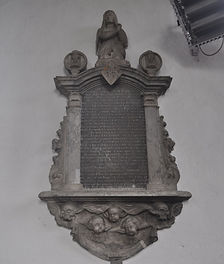


Monument to Dame Anne Parkyns d 1725
Standing against the north wall of the nave is a memorial to Thomas Parkyns. This used to stand in the chancel, at the eastern end of the north wall before being moved to its present position in 1912. The monument was designed by Parkyns himself prior to his death in 1741. It consists of two sections, each under a rounded arch. To the left as we look at it we see a life sized depiction of Parkyns in a wrestling pose with death in the form of Old Father Time, minus his scythe having lost his hands, and hourglass on its side at his feet; symbolic of time having run out for the deceased. Parkyns lays alongside on a mat deceased with text in Latin reading ‘TEMPUS EDAX RERUM’ which translates as ‘Time the devourer of all things’. Further text in English reads ‘That time at length did throw him it is plain /Who liv’d in hopes that he should rise again’
The other stained glass window here; with a two light window at the east end of the north aisle showing a very smart looking John the Baptist calling on those gathered to repent and be baptised.


Moving back outside some gravestones are still standing but most are laid down and are gradually being overtaken by nature. The name Elizabeth is visible still; the rest of the stone apart from a few words of script now covered by grass. Close by we see a carving in slate depicting an angel blowing a trumpet and holding an eternal flame. The trumpet is an often used symbol of the resurrection and the eternal flame is turned downwards which symbolises death and mourning. Two opposing symbols, acknowledging the death but glorying in the resurrection that those judged to be righteous will find on the final day.
One epitaph still readable, though the name of the deceased is lost beneath the grass reads ‘Death how couldst destroy/A father’s hope a mother’s joy/As he was lov’s by his friends sincere/Now is sacred dust he lies mouldring here/May he rise where bliss supreme is given/And mingle with the blest the saints in Heaven’.


It was time to move on; aiming the short distance to the north where we were delighted to find what remains of the church at Bradmore, only the tower and spire remaining after fire destroyed the rest of the church in 1705. A brick room was added to the tower in 1881 and it was open that afternoon for teas and coffee with an art exhibition on. From then we visited Plumtree and Keyworth, with each being open; before arriving at Keyworth football club where the afternoon was to get a little noisier and windier! It had been a good day.