Come Ye Blessed...
LANGAR
CHURCH OF ST ANDREW

Church Post Code NG13 9HG
Open to visitors
There are nine Vale of Belvoir Angel gravestones to be found in the church grounds here.
A stone to one Robert Simon is a very fine example; two angels are finely carved across the top, with 'Remember Thy End' enclosed within a heart in between. The details of the deceased are carved in relief, the area around the letters being carved away so that the letters themselves stand proud of the grave. A real skill!
The stone reads 'Here lyeth the body of Robert Simon who departed this life April the 8th 1732 his age 36 years'
(not in relief)... 'He loved peace and quietness who here interred lies his reward is eternal bliss above the starry skies'
At the bottom reads 'Blessed are the peacemakers for they shall be called ye children of God' Matthew Chapter 5 verse 9.
The gravestone to William Simon is of great interest but is battered and bruised. The angel has lost one wing. An hourglass, a symbol of the mortality of Man, can be seen on the top left as we look at it. The crossed bones which would have been present in the top right have also been lost.
The stone reads 'Here lies the body of William Simon Senior, son of William Simon by Barbra his wife he died ye 8th day of May 1713 ages 50 years'
A fascinating inscription can be seen at the foot of the grave 'Reader stand still and shed a tear Upon the dust that sleepeth here and whilst thou read of the state of me then think on the glass that runs for thee'.
In those days, the phrase 'my glass is run' was used to described a life that had been completed. Here, the onlooker is reminded of his or her own mortality; their own glass is running! Don't be caught short when your time comes. Heaven awaits for those who believe in God and who persevere in their faith to the end.


A gravestone to Martha Vanners, is quite badly weathered, but still readable. The angel peers out from a veil of white algae It reads 'Here lies ye body of Martha, the wife of Claybrook Vanners who died November 26th 1714 aged 31 years'
I only have a partial inscription from the foot of this grave, the remaining couple of lines having sunk in to the earth 'Though death has parted you and I our bodys to dust must turn I hope that we shall meet again you have no cause to mourn'
Another double angel gravestone, again with 'Remember Thy End' enclosed within a heart is a memorial to one Robert Bell, a gardener. It reads 'Here lies the body of Mr Robert Bell gardener who for his capacity in his business and fidelity to the noble family that he had the honour to serve has left a comendable example He died March ye 7th 1728/9 aged 38 years'.

Another gravestone of superb quality and craftsmanship is to Henry James Senior. 'To die is gain' is carved across the top, with the first four lines carved in relief. As is often the case though, there were problems with spacing. The second 'd' in died is crowbarred in so to speak and the age of the deceased is in smaller font with the word 'year' fitted in above.
The curious thing here for me though is when the reader looks at the inscription below. It is a grave for a husband and wife, although there is no mention of the wife's name anywhere.
The gravestone reads 'Here lyeth the body of Henry James Senr of Barnston he died Apr 11th 1730 aged 58 years'
'A loving husband and a virtous wif here les confined both to leave this life and tho their bodys do return to dust their souls I hope are dwelling with the just'
'Blessed are they yt (that) in the Lord they die from their labours they rest eternally'.
Perhaps the wife of Henry James was Anne. Her gravestone is nearby and she is recorded as being the wife of Henry; with the dates fitting.
This gravestone reads 'Here lies the body of Anne wife of Henry Janes of Barnstone in this parish she departed this life November ye 29th 1720 in the 42nd year of her age
The very weathered inscription across the top of the stone reads 'Blessed are the dead that die in ye Lord'
The inscription lower down is as follows...
'Sleep thou blest creature in thy vines my sighes and teares will not awake thee I must true my appointed time and then O then I'll overtake you'


Another double angel gravestone reads as follows... 'Here lies the body of John Beeston who died Feb the 27th 1729 in the 27th year of his age'
Another quality piece of work, which has sadly sunk in to the ground a great deal, the inscription lower down being lost as a result.
The Heathcote's study of these gravestones recorded one to Elizabeth Peacock. They visited Langar in 2009 and recorded this gravestone as having fallen and been partially buried.
I missed this one when visiting in 2021, or perhaps it has been moved. There is a photograph of this grave in the Heathcote's book and the inscription on it is as follows..
'Here lied the body of Elizabeth Peacock and her two daughters Margret and Elenor. Margaret died February 13th 1735.
The ninth and final Vale of Belvoir Angel stone in the church grounds here is to Sarah Simon, it reads
'Here lyeth the body of Sarah the daughter of Robert and Anne Simon his wife She died Jan ye 17th 1728 aged 3 years and a half'.
These were hard times for the people living then. The gravestone to her father stand close by and he passed away himself four years later at the age of 36 years.
Further down the stone, carved in relief is the following 'Also Robert Simon son of Robert Simon by Anne his wife died in his infancy'.
Further inscription reads 'Death crops ye flower ye blossom and the bud Happy and blest are they whse lives are good here we lie sleeping till our tender days shall sing our makers everlasting praise'
'Do not for us in tears remain your loss we hope will be our gain'.

SOME NOTES FROM MY VISIT
Exterior Photographs Used Are A Combination From Both Visits.
It was a fine and sunny Saturday during lent 2023; and a revisit to the church of St Andrew at Langar. My original visit, back in 2021, was mainly to photograph the Belvoir Angel gravestones in the church grounds here, with the church closed to visitors that day due to ongoing covid restrictions.
The area here is very picturesque and popular with walkers and there were quite a few cars parked up close to the church when we arrived; with the walkers enjoying the sunny day and the first real sense of warmth in the sun that year.
This Nottinghamshire village recorded a population of 962 at the time of the 2021 census, with this figure also including neighbouring Barnstone which is a short distance away to the north east. Grantham, in Lincolnshire, is some 15 miles away to the east. Melton Mowbray, in Leicestershire, is around 12 miles off to the south. Belvoir Castle is a familiar landmark across the field to the east. The outskirts of Nottingham is 12 miles or so away to the north west.
The church of St Andrew sits pleasantly isolated at the extreme north west of the village. The church that we see today consists of central tower, nave with north and south aisles and clerestories, south porch, north and south transepts, north vestry and chancel.
There was a church recorded here at the time of the Domesday Survey in 1086, on lands that were owned by William Peverel, a trusted supporter of William the Conqueror; with Langar being one of 150 manors granted to him.
The present structure dates mainly from the 13th century and it is suggested that the previous church here would have been on a different site. There was restoration and rebuilding here during the 15th century, at which point the south porch was added, with walls being heightened and clerestories added. The battlements date from this time as well.


Looking at the church from the south the three stage tower has two narrow shuttered lancet windows on each side at the belfry stage; these flanked by blind arches. The church clock looks out from the south and east faces.
The church is buttressed and battlemented throughout; with the south transept having three lancet windows of which the central rises higher. At the outer edges of the label stops of these windows are small human heads; these being the only real ornamentation on the whole of the exterior.
There was extensive Victorian restoration here during the 1859, with work carried out by Revd Thomas Butler who was the rector here between 1834 and 1876. At this point the tower, which had been sinking, was rebuilt. The work was not enthusiastically received by all though with Pevsner noting that it was ‘so vigorously restored that little of its original surface remains’. Even so, this is still a very impressive exterior; with the church being known to some as the ‘Cathedral of the Vale’.


There are five bells in the ring here, with this ring replacing a previous ring of four; which were all recast, with a fifth bell added, during the restoration of 1859, all cast by Taylor of Loughborough.
The previous ring of four was as follows. The first was cast by Henry II Oldfield of Nottingham in 1611. This was inscribed ‘I sweetly toling men do call to taste on meats that feed the soole’. The same founder cast the fourth of the ring in the same year; with this one having the inscription ‘HEC CAMPANA SACRA FIAT TRINITATE BEATA’ which translates as ‘May the Holy Trinity bless this bell’.
The third of the ring was also cast by Henry II Oldfield, but this one is dated earlier, in 1601. This bell was inscribed ‘IN NOE XPI OME GENU FLECTAT CELESTM TRISTRIM ET INSTORN’ which reads ‘In the night I will bend my knee to the celestial throne and rise’.
The second of the ring was dated 1636 and is attributed to George I Oldfield, who was the son of Henry. This one had the inscription ‘NON NOBIS DOMINE NON NOBIS SED NOMEN TUO AD GLORIAM’. This translates as ‘Not unto us O Lord not unto us but to your name and glory’.


Moving inside, there are five bay arcades to north and south, each dating from the late 13th century, with each having circular piers with moulded capitals. A red carpet covers the whole of the nave; not just a narrow path through to the chancel. At the time of my visit the chairs, had been moved in to several large semi circles facing north, towards a temporary altar which stood in the north aisle. The south aisle is interesting, with the eastern end being raised; a flight of steps leading to a raised platform on which is a bier and a local historic display.
Moving in to the chancel the restoration of 1859 appears to have erased much of the history with sedilia and piscina absent from the south wall and no aumbry on the north wall. The east window is of five light and of clear glass. The altar has a violet cloth which is a liturgical colour used during Lent.
In the south transept, which is screened off and locked, we have a monument to the ‘Right Hon. and Noble Lord Thomas, Lord Scrope Baron of Boulton, Masham and Upshai’ who died in September 1609. He lays alongside his wife Philadelphia Carey, dressed in armour, sword at his side with both having their hands raised in prayer. His wife is an interesting character; who was the Lady of the Bedchamber to Queen Elizabeth I; was evidently a trusted confidant to the Queen and was close to the Queen’s bedside when she died in 1603. Sat at the feet of his parents is their single son Emmanuel, a small figure with long bear who holds a Bible.


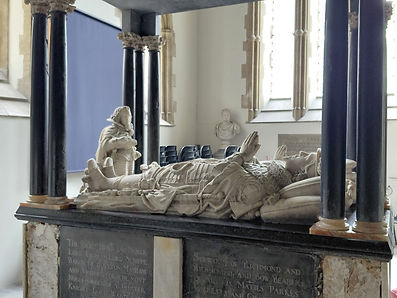


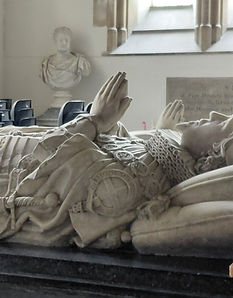
The north transept is screened off and is locked to visitors. Within this transept there are memorials to three generations of the Chaworth family, from Wiveton Hall to the north of Langar. Vision was restricted; shooting through the screen, holding back a curtain in one hand, and being very careful not to drop my mobile phone, I managed to get a few shots. Here we see a plain altar tomb to George Chaworth who died in 1521 and his wife Katherine who died in 1517. We also see a marble monument to Sir John Chaworth who died in 1558 and his wife Mary. My view of this memorial was restricted but we see the two figures recumbent, hands raised in prayer. He is dressed in armour with head resting on his helmet and a dog at his feet. I could see very little of Mary but her head rests on two pillows. Weepers, possibly their children, surround the monument, again with hands raised in prayer, with several of these shrouded to indicate that they had died before their parents.
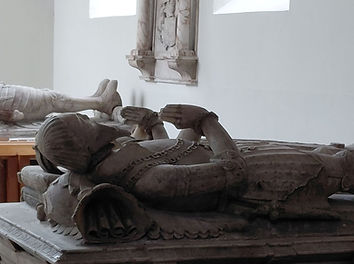
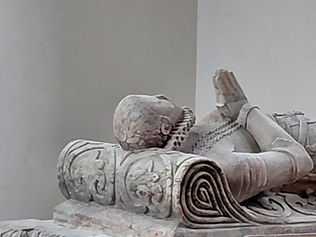
We also see a memorial to Sir George Chaworth who died in 1587. He cuts lonely figure, laying on his own, dressed in armour and with hands raised in prayer; sporting a fine Elizabethan ruff with head resting on a rolled up carpet which extends out to cover his whole body; his feet also resting on it.



There is little in the way of stained glass here but there is a three light window mat the west wall of the nave. This is of interest; having a couple of depictions that I can’t recall having seen before. The central panel shows the crucifixion; Jesus crucified with the three Mary’s and John alongside the cross. Alongside we see a depiction from Hebrews Chapter 11 verse 4 where Paul is speaking of faith and in particular the faith of Abel through his offerings, which still speak even after his death. Pictured we see Abel with hands raised in worship; alongside the fire on which sits his offering to God.
Abel’s offering was acceptable and the memory of this has lasted after his death. An angel holds a banner on which it reads in the Kings James version ‘He being dead yet speaketh’. The end of verse 4 in the Message version, which is a modern paraphrase, reads a little more clearly ‘After all these centuries, that belief continues to catch our notice’.
Abel is dressed in a red cloak, this being symbolic of his blood shed after his brother Cain, who was jealous that Abel’s offering was pleasing to God and his wasn’t, murdered him.
The right hand panel as we look at it has a depiction of events immediately after the crucifixion. Jesus has died on the cross and the curtain in the Temple was torn from top to bottom. We see pictured an angel, with white wings unfurled, holding open the torn edges of the curtain; peering in inquisitively with golden light pulsating out.


The church grounds here are of great interest with the majority of the gravestones being of slate. I was mainly here for the Belvoir Angel gravestones; which are amongst several early to mid 18th century gravestones which have their own Grade II Listing.
Just to take a very quick look at a couple of other carvings; on one a female figure stands, holding on to an anchor with a cross standing close by. Each of these is a symbol of the Christian faith with script on a banner from Hebrews Chapter 6 verse 19 reading ‘Which I hope we have as an anchor both sure and steadfast’.
Close by we see the same two symbols used, along with the skull and crossed bones below; each of these being a symbol of mortality. A book is open upon which is written ‘As in Adam all die so in Christ all will be made alive’. This acknowledges that death is inevitable; a part of life but those who believe and trust in Christ will physically die but will move on to eternal life in Heaven.
We often see epitaphs which make for heavy reading. Times were hard, life expectancy was low and throughout the area there are stories of faith despite hardships. You will see plenty of those in the pages of this site; something a little different here though on a stone to Ann Goodacre who died aged 56 years in November 1747. The epitaph reads ‘A virtuous wife unto whose Heavenly mind/Both wit and temper nature friendly joined/And as their years so did their loves increase/They lived contended and she dy’d in peace’.


