Come Ye Blessed...
GADDESBY
CHURCH OF ST LUKE
Church Post Code LE7 4WE
Open to visitors
There were five Vale Of Belvoir Angel gravestones recorded by the Heathcote's in their study. Sadly, a couple of the stones here have sunk deeply in to the ground with much of the text now being below ground level.

Close by is a gravestone to William Hardy. This stone has the hour glass and crossed bones.
The stone reads 'Here lyeth interred the body of William Hardy who departed this life Oct 26th 1702 in ye 78 year of his age'
'Anne ye wife of William Hardy died October 12th 1704 aged 66 years'
Fascinating to look at William's year of birth, which would be 1624 ish! He would have been a young man when the English Civil War started; perhaps he even fought! He would have been early 40's when the Bubonic Plague swept the country!
'Come Ye Blessed' is carved across the top of this rain splattered stone to Mary Hardy.
The stone reads 'Here lyeth the body of Mary the wife of Thomas Hardy She departed this life January 3rd 1705'.
'Pale death will hardly find another So good a wife so kind a mother In all her actions so discreet is she who lies here at your feet'.
In all likelihood the term 'Pale Death' comes from Revelation Chapter 6, the first part of verse 9 where it says 'And I looked, and behold a pale horse: and his name that sat on him was Death'.
This was the fourth horseman of the apocalypse and it has been suggested that the colour of this horse was like the sickly pallor of a corpse!


The gravestone to Thomas Franke is leaning over at an angle and partially obscured by another stone which is leaning over in front of it.
'Here lieth interr'd the body of Thomas the son of Thomas Franke by Elizabeth his wife he died the 13th day of February 1702 and in the 4th year of his age'
The epitaph below is mostly obscured by the gravestone leaving in front of it. However a little of it can be seen and it is a fairly common rhyme; one that was often used when a young child passed away. It is liable to say 'Short was his race long is his rest God takes them soonest who he loves best'.
The stone to George Burbidge has sunk very badly in to the ground. What remains is the angel, who is scowling, and a few words of text.
Any epitaph at the foot of the grave is lost to view. What can still be seen is as follows...
'Here lyeth the body of George Burbidge he died (unreadable) 1749 aged 75 years'


The fifth and final Vale of Belvoir Angel stone here is another to have leaned over and sunk a little. It is also not the easiest to pick out detail from. In its time, this would have been a beautiful piece of work.
This is a finely carved double angel stone, 'Be Ye Ready' carved in to a heart shape between the angels.
The text that we can still see is carved in relief, a time consuming and skilled process where the background around the lettering is chiseled away leaving the letters themselves standing proud of the stone
'Here lyeth the body of Anne daughter of Robert Barsby by Mary his wife who died July the 31st 1733 her age (unreadable)
SOME NOTES FROM MY VISIT
I made two trips to see the church of St Luke at Gaddesby. The first visit was on a gloomy day in the summer of 2020, Covid 19 was still a real problem at that time and we were between lockdowns; travel was allowed and churches were allowed to be open for private prayer but in truth though very few were and St Luke was closed on the day.
We revisited in early July 2026, on a gloriously sunny and warm Saturday, with St Luke being the second church of the day visited on an eight church crawl which started in Leicestershire; crossing the county line in to Nottinghamshire briefly during the afternoon, with photographs used being from this revisit. However, I have kept the photographs of the Belvoir Angel gravestones themselves from the original visit; they being a little easier to read in the dull lighting and away from the glare of the sun.
Gaddesby, pronounced ‘Gaddsby’ by the locals is a small village in the Melton district of Leicestershire, which recorded a population of 737 at the time of the 2021 census; with this figure including the neighbouring hamlets of Ashby Folville and Barsby.
The centre of Leicester is some 15 miles away to the south west; Melton Mowbray is around seven miles away to the north east. The church of St Luke can be found in a pleasant tree lined area to the east of the village; quiet and peaceful, set back from the main road which runs through the village.


There has been a church here since the early 12th century, with that original structure being a simple single cell building with a small chancel and a south porch. The church was extended over the centuries; with donations from wealthy benefactors (this was a very prosperous area in medieval times) and there would also have been financial contribution from the Knights Templars. In 1231 King Henry III had granted the Templars the Soke and manor of Rothley and this included the manor of Gaddesby. The result is an impressive church, which is seen as one of the finest parish churches in Leicestershire.
The need for more space saw the addition of a south aisle around 1230, at which time the west tower was started; with work ongoing here until the 14th century.
Shortly after the addition of the south aisle, a north aisle followed with a new chancel being built. The aisles were altered, with westward expansion of the south aisle to allow for a chantry chapel, founded by Robert De Gaddesby ; where masses would be said for him and his family to reduce the time that they would spend in purgatory after their deaths in those pre reformation days when the state religion of this country was Catholic.
The north aisle was taken down, and rebuilt in around 1330, wider and again expanded to the west; leaving the tower fully enclosed by the aisles. Walls were heightened and clerestory windows added to improve the lighting inside as the church grew in size.
In 1340, just before the Black Death did its worst, work was undertaken on the west end of the south aisle, where the chantry chapel was’ embellishing it in the decorated style. .Fascinating to think that we are looking at the work of people just before the onslaught of the Black Death which is estimated to have killed around half of the population of England! Around 1450 the chancel was rebuilt and Victorian restoration came about in 1859, at which point the chancel was restored and a priest's door added.


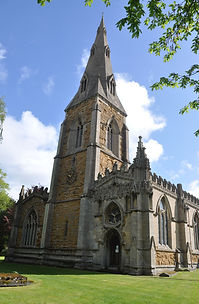
The church that we see today is built of ironstone and limestone ashlar with ashlar dressings and consists of west tower, nave with north and south aisles and clerestories, south porch and chancel. Taking an initial look around the exterior this is a church of pleasing and impressive proportions; indicating the wealth of the area when the church was being built.
The tower is of three stages, buttressed and rising up from within the western ends of the north and south aisles. An octagonal broach spire rises up to a height of 130 feet; this having three tiers of gabled lucarne windows. The church clock faces out from the west face. The north aisle is highly decorated; battlemented and pinnacled with gargoyles looking out.
Moving around the exterior we can see the outline of the pre clerestory roofline still clearly visible on the east wall of the tower and a little less clearly visible on the east wall of the nave. We can also see the outlines of two previous rooflines of the south porch.
The south aisle is less ornate until we get to the west of the south porch; where the chantry chapel would have been. This is heavily decorated with the work, as mentioned earlier, coming before the start of the Black Death. A frieze of an ornately carved quatrefoil design has a corbel string below which contains a variety of carvings; some grotesque others cartoon like. We see a human figure in despair, with hands on head, a dog which may be a representation of a beloved pet. We see various animals including a wonderful depiction of a pig; a lion stands alongside a mitred Bishop and a Green Man with all figures connected by a scrolling vine.
The west end, which was difficult to photograph due to the positioning of the sun, is particularly ornate with fine triangular window above the west doorway and a row of finely carved crocketed canopies, several of which are blank but others have a recess which at one point prior to the reformation would have help statues.
What appears to be a type of owl, but not a type of owl that anyone has ever seen, looks out through sunken eyes; grimacing and showing a full set of teeth that in a human would be a more attractive feature than is seen in an owl!


When Thomas North saw his study of the church bells in Leicestershire published in 1876 there were three bells in the ring here. The first and third were each cast by William Noone of Nottingham in 1712. The first has the inscription ‘God Save the King’ with the third inscribed ‘God Save His Church’. The second is dated to around 1580 and was cast by Newcombe of Leicester, possibly Thomas II Newcombe if the date of 1580 is accurate.
Today though the situation is very different with eight bells in the ring; each of the subsequent five cast by Taylor of Loughborough with three bells added in 1964 and a further two in 1972.
Moving inside, there are five bay arcades to north and south; nave is separated from chancel by a Victorian screen. Moving to the chancel and looking west the outline of the pre clerestory roofline is visible against the west wall; a small doorway below. The flooring in the nave is ancient, showing the tread of thousands of pairs of feet over hundreds of years. Also of great age are the pews, which date to the 16th century. There is a relaxed feel here with tables set out at the west end of the nave and also in the north aisle.


Moving in to the chancel, the altar had a green cloth; this being the liturgical colour used in ‘Ordinary Times’; the times between the major Christian festivals, in this case the time between Pentecost and Advent. There was much Victorian restoration here but the piscina and aumbry, to be found set in to the south and north walls respectively, are each medieval survivals.
When I visited the church at neighbouring Ashby Folville some months before, I was told to look out for a statue of horse and rider in the chancel at Gaddesby, which is what the church here is probably most famous for. Set against the north wall of the chancel this is a near life size depiction of Colonel Edward Chaney of the Royal Scots Greys, who fought at the battle of Waterloo in 1815. It is said that Chaney had four horses shot out from under him during the battle; rising up to lead his troops from the fifth. This sculpture, by Joseph Gott was carved in 1848, the year of Chaney’s death and stood at Gaddesby Hall; the Chaney’s home, before being moved to the church in 1917 after the Hall was sold.
Here we see Chaney riding his horse, who is mortally wounded with a bullet wound to the chest. The horse has collapsed and Chaney is about to dismount, sword in hand; empty scabbard at his side. Carving on the base show cavalry attacking foot soldiers; a truly fabulous work!
The east window is of five lights and has stained glass dating from 1892, made by Heaton Butler and Bayne. Central is the crucifixion with interestingly only Mary Magdalene alongside the cross, head down with long hair hanging down. To the left of this we see Mary the Mother of Jesus meeting her son as he carried his cross to the site of the crucifixion; with John leading her away from the cross a little later. To the right we see Peter and John looking in to the empty tomb, with Jesus talking to Peter and John far right. Peter is kneeling and I think that this might be the reinstatement of Peter.


Moving in to the north aisle we see the recumbent effigy of an unknown Knight, dressed in armour, hands raised in prayer, with head resting on his helmet; a lion at his feet which is thought to date from around 1500. Close by we see an incised slab to William Derby and his wife. He is dressed in armour, she has an elegant gown with tiny waist; each have their hands raised in prayer. He died in 1498.
Interestingly there are stone benches to the north and south of the south aisle which are of great age. Originally there was no seating for the general congregation in medieval churches but stone benches were set against the nave walls for the weak and infirm. This led to the term ‘the weakest go to the wall’.
Looking at the details on the Belvoir Angel gravestones we are used to seeing how short and harsh life could be back in the 18th century; a series of ledger slabs within the church here also indicates how this carried on through in to the nineteenth century. It was still possible to live a long life but some of the slabs here record those who have lived through childhood but who died as a young adult.
Sarah, the daughter of Joseph and Mary Haines died in November 1846 aged 22 years; with William Haines who died at the age of one year recorded on the same stone; with the two passing away within three weeks of each other. Her epitaph illustrates the fragility of human life and for those looking on to be prepared for their own death and to trust in God; as it says on Belvoir Angel gravestones ‘Be Ye Also Ready’ Her epitaph reads ‘Death little warning to me gave/But quickly took me to my grave/O! Haste to Christ no time delay/I in my prime was call’d away’.
Some of the epitaphs are still moving, long after their passing. A ledger slab to Eliza Whait, who passed away in 1870, again aged 22 years, reads as follows ‘Long were my sufferings and intense my pain/With restless days and sleepless nights opprest/ My friends to ease me strove but strove in vain/Til Christ was pleased to take me to his rest’.
Worth noting that these were people of wealth; to have a ledger slab in a church you had means. How much worse might things have been for those who had little!


Taking a look around the church grounds I was primarily concerned with the Belvoir Angels already mentioned. However, in amongst the slate gravestones there is much of interest. Just to pick out a few though; as always the message passed on to the onlooker was to acknowledge the fragility of human life and your own mortality. Do not be caught short when your own time comes; as in days of low life expectancy it could be later than you think.
A depiction of a human skull has the word ‘Mortality’ carved in to it; a snake slithering around it. Script on another says simple ‘Be Ye Also Ready’. A slate gravestone to Thomas Hardy who died in 1734 aged 57 years has the epitaph ‘Farewell dear friends since God will have it so/Tis sin to murmur at his will you know/ He now doth lie asleep within this bed/Until the resurrection of the dead’.
This stone is rich in symbolism with crossed human bones, a symbol of the mortality of Man, below the epitaph flanked by two sets of symbols, an hourglass and the gravedigger’s tools of pick and shovel. The gravediggers tools are another symbol of mortality; the hourglass a reminder of the passing of time and the inevitability of death ‘Tempus Fugit’ time flies.
Each of these sets of symbols is encircled by an Ouroboros, a serpent with its tail in its mouth, which was an often used symbol for eternity. Read together we see pointed out the inevitability of death but eternal life for those who will be judged righteous on the final day.
Photographs taken in the church grounds are again included from the original visit when the lighting was a little less bright. Loved the Red Hot Pokers providing a little colour on a drab morning.


The church of St Luke was open and welcoming and is well worth taking a look at if you are in the area; with lots to see for the interested visitor. A lady at the church told me that there is a regular coffee morning held here on the second Sunday of each month so perhaps the church and a slice of lemon drizzle might be combined. We headed north to neighbouring Rotherby; our Leicestershire crawl continued.