Come Ye Blessed...
WOOLSTHORPE BY BELVOIR LINCOLNSHIRE
Post Code NG32 1LT
Woolsthorpe Upper Cemetery - grounds only of previous church.
There were two Belvoir Angel gravestones recorded here in the Heathcote study. These are both in the old St James churchyard; with the church here being burned down by Parliament forces who were bivouacked here during the siege of Belvoir Castle in 1643. The church grounds here were used for a long time after the church was destroyed with a new chapel of St Mary being built in the village. This in turn was taken down in 1793 with a new church with the same dedication being built. The present structure, which I will take a look at shortly, was built primarily between 1845 and 1847, by architect GG Place of Nottingham, with the tower completed in 1893.
'Memento Mori' is inscribed within a heart shape, between two Belvoir Angels, in this fabulously crafted stone to a married couple who died within a short while of each other.
This stone reads 'Here lyeth the body of Edward Guy & Jane his wife Edward departed this life October the 9th 1727 aged 81 years Jane departed this life November the 20th 1726 her age 73 years'
A brief epitaph is charming and says 'She first deceased he a little try'd to live without her liked it not and died'
At the foot of this grave it reads 'Blessed are ye dead which die in ye Lord', which is taken from Revelation Chapter 14 verse 13.

The second gravestone here is another finely crafted double angel stone. This one has sunk in to the ground a little and is leaning forward, which meant that I could not make out the inscription at the foot of the stone.
'Be ye ready' is inscribed within a heart shape between the angels, a warning to the onlooker to be prepared to follow in the footsteps of the deceased, who himself was taken at an early age.
What I could read says 'William son of Matt Remeton by Mary his wife died May the 6th 1730 in the 12th year of his age'


CHURCH OF ST JAMES

Church Post Code NG32 1LX
Open to visitors
Some Notes From My Visit
It was early March 2026 and there was a full days churchcrawl planned; starting off the day in South Kesteven, Lincolnshire before crossing the border in to Nottinghamshire. We had begun at Grantham in foggy conditions, before moving on to Denton and Harlaxton with the church of St James at Woolsthorpe by Belvoir being our fourth church of the day.
Please note that there are two Woolsthorpe’s in Lincolnshire, with the other being Woolsthorpe by Colsterworth, the birth place of Isaac Newton, which can be found close to the A1 across the field to the south east.
Woolsthorpe by Belvoir can be found to the south of the A52 which connects Grantham to Nottingham, with the former roughly five miles as the crow flies off to the east. Melton Mowbray is some 12 miles away to the south west. The parish recorded a population of 398 at the time of the 2021 census.
There is plenty of history here with finds dating back to Roman times. The village was mentioned in the Domesday Survey of 1086 with a church and priest mentioned in lands owned by Robert of Tosny.
The village here is very close to the Leicestershire border; Belvoir Castle is a neighbour close by across the fields to the west, with that being in Leicestershire. The church of St James can be found central, alongside the main road which runs through the village.
As mentioned earlier on this page there was a medieval church here which was destroyed by Parliamentary troops during the English Civil War. The church that we see here today is of Victorian construction, being built between 1845 and 1847 by architect GG Place of Nottingham; at a cost of £3500,with the foundation stone being laid by Lady Azelia Manners from Belvoir Castle, who also painted the wall decorations in the chancel. The tower was not completed until 1893.


This was a return visit; initially visiting here back in the winter of 2012, part of a four day cycling tour of the churches in the area; whilst staying in digs at Grantham, a bitterly cold day which left me questioning my life choices for a time! The church of St James was closed that day; as was the same during a visit during the summer of 2020 when the vast majority of churches were closed to visitors due to covid concerns. The church was open to visitors on this March 2026 revisit,
The church that we see today is of ironstone rubble with limestone ashlar dressings. It is built in the style of the early 14th century; possibly designed in the same style as the original burned down church, It consists of west tower, nave with north and south aisles and clerestories, south porch, north vestry and chancel.
Looking at the church from the south the three stage west tower stands proud above a couple of trees; buttressed, battlemented and with crocketed pinnacles rising up from the four corners; with the pinnacle to the north east damaged and not rising up quite as much as the others.
There are steeply pitched tile roofs at the nave and clerestory; the clerestory itself consisting of three tiny windows in a quatre foil shape, each contained within a roundel. Occasionally I see clerestory windows, designed to let extra light in, and wonder why they are so small; the size appearing to defeat their purpose. This is one of those times.
A King and Queen look out at visitors making their way to the south porch; stone heads look out from various vantage points including a female figure which has her mouth covered. My initial thought that it was a scold’s bridle; a device that was a cage like device attached around the mouth of a woman who was deemed to be a gossip or argumentative but this appears not to be the case. This is just a covering over the mouth which may just be a depiction to the onlooker of the perils of loose lips!


One other male figure wearing a helmet has the most magnificent twirly moustache; a female figure close by, wearing a headdress, looks on serenely. From the south the chancel is lost behind some trees, moving around to the east the east window is of five lights.
There are two bells in the ring here, which was looked at by Thomas North in his study of the church bells of Lincolnshire, which was published in 1882. He noted that these were each cast by Thomas II Mears in 1820. I am assuming that these hung in the chapel of ease that stood here on this site before the present church was built.
I couldn’t find any information on the bells that hung in the old church here that was burned down; in fact there is very little information on this church at all. North does note though that there was no ‘sacring belles’ (small hand bells used during the Mass to announce the Elevation of the Host) at the time of Queen Mary with one hand bell having been previously stolen.


Moving inside, my concerns about the small nature of the clerestory windows were I think justified. It was bright and sunny outside but a little dull inside, with stained glass in several windows to the south also preventing some natural light was getting in.
There are four bay arcades to north and south with each having octagonal piers and capitals. There is a nice relaxed feel to the interior; there are no pews and modern chairs can be moved to accommodate the needs of the day. Tables were set out for refreshments and I had a lovely time being photographed with some cuddly toys in the children’s area at the south west end of the nave. Sadly, I couldn’t quite fit in to the toy plastic car! The tower arch is steeply pointed and of three orders.


Moving in to the chancel the east window is of five lights and was the work of Ward and Hughes of London. This window shows the crucifixion central. Christ is crucified against a symbolically blood red background; flanked by Mary the Mother of Jesus and St John, who are in their traditional positions alongside the cross. They are in turn flanked by St James and Mary Magdalene. St James, after who this church is dedicated carries a church (but this is not a visual of the present church here) and has the scallop shell, a symbol associated with him at the top of his nimbus. Mary Magdalene carries a jar with which she had anointed the feet of Jesus in the days leading up to the crucifixion.
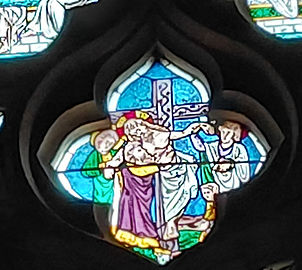
Up in the tracery we see scenes from Holy Week, including the Last Supper, the Crucifixion, the Deposition and an angel of the Lord appearing to the three Mary’s on Easter morning; pointing upwards towards Heaven, ‘He is not here He is risen’.
The chancel is ornately carved, with triple sedilia and piscina against the south wall and elaborate tomb recess against the north wall. I suspect that all of this is from the time of the Victorian building of the church with nothing having survived from the original medieval church. The sedilia and piscina are both ogee headed and possibly may have been carved in medieval style in memory to the destroyed church.




Angels with wings unfurled flank the tomb recess; with a close look showing a carving of a nun and a creature with its tongue out in gesture of insult; with smaller angels holding shields at the label ends of the north vestry doorway. Script over this doorway reads ‘May thy priests be clothed in righteousness’ which is part of Psalm 132 verse 9. Higher up we see gilded angels blowing trumpets and a further angel holding out a laurel wreath of victory. One further angel with wild hair holds a scroll on which is contained the script ‘Holy, Holy, Holy’. The walls are painted with floral designs; by the hand of Lady Manners as mentioned earlier.


Other stained glass includes a three light window that shows St Matthew, St Phillip and St John; with the latter shown holding a quill. Further windows show disciples with symbols which denote the manner of their martyrdom. We see St James the Less holding a club, St Bartholomew holding a skinning knife, with St (Doubting) Thomas holding a spear. We also see St Jude (Thaddeus) holding a long handled hatchet and St Simon the Zealot who holds a saw.
St Peter is easily identifiable by the fact that he holds the keys to the Kingdom of Heaven but this is an unusual depiction as he is shown with a full head of hair. Also present is St James the Great who is shown holding a Pilgrim’s staff and St Andrew who is shown with saltire cross.
We also see the Last Supper and the Ascension. The Last Supper is interesting as only Jesus is shown with nimbus (halo). John, who is as always, is shown as being much younger than the others, leans in against Jesus. Judas Iscariot, who was shortly after to betray Jesus holds the money bag. The depiction of the ascension shows Jesus ascending before the eleven remaining disciples, surrounded by a golden but slightly underwhelming aureole.


It was good to see inside this church for the first time; enjoyed my brief stay here very much. The church here is well worth a look if you are in the area, with the old church grounds a short distance out of the village to the west.
This was my fourth church of the day and the fourth that was open. We continued that open sequence; crossing the border in to Leicestershire to visit Bottesford before entering back in to Lincolnshire to Claypole. The afternoon was spent in Nottinghamshire, at Newark and Southwell Minster. Eight churches open out of eight on the day. A good day’s crawl in a lovely area!