Come Ye Blessed...
ROPSLEY LINCOLNSHIRE
CHURCH OF ST PETER
Church Post Code NG33 4DA
Open to Visitors
The Heathcote study stated one Vale of Belvoir Angel gravestone in the church grounds here. There actually is two though, with the second coming to light through some tracing their family history and uploading a photograph of the gravestone on to the Belvoir Angels Facebook page.

The one recorded by the Heathcote's reads as follows...
'Here lyeth the body of John Pickwell who died Nov 20th 1730 his age 62 years'
There is a fair amount of damage to this stone. It is a double angel gravestone but the angel on the left as we look at it is gone with the exception of a small part of one wing. The angel on the right is damaged but substantially there.
In typical style, there are some spacing issues with the word 'died' being added in small font underneath where it should have gone!
Inscription at the foot of the stone reads '
A husband kind a father dear the same is he who lyeth here God gave him time for to repent and for his sins he did lament'
The second Vale of Belvoir Angel gravestone came to light a couple of weeks after I had visited this church.I missed this one so no photograph. The stone is quite badly damaged, lying flat, close to the porch.
The stone itself is quite badly damaged; another double angel stone which reads 'Here lies interr'd the body of Mary the wife of Benjamin Goulson died January 21st 1729 aged 54 years' (some text missing)
The inscription below is also incomplete and it is not one that I have come upon before. There is too much missing of the first two lines to guess at but the final two lines read 'I refused not any lamented by many'
SOME NOTES FROM MY VISIT
We moved on to Ropsley; the largest of the seven villages in the North Beltisloe benefice. The church here was open and it was lovely to be able to see inside. I was here several years ago, with a very basic digital camera and it was always the intention to revisit with the Nikon one day; it just took around 15 years, no point in rushing! It had been a dull start to the day, but the promised sun had finally beaten the stubborn morning cloud cover by the time that we reached Ropsley, the fifth church of the day visited.
Ropsley is a very pleasant South Kesteven village, which recorded a population of 634 at the time of the 2021 census. It can be found some five miles to the east of Grantham. The church of St Peter can be found off to the south of the village, on slightly raised ground. A black and white cat, after a fashion, came up and sort of said hi, before losing his or her nerve and fleeing off in the direction of the nearby retirement bungalows.


The church that we see today consists of west tower with octagonal broach spire with three tiers of gabled lucarne windows, nave with north and south aisles and clerestories, south porch, south chapel and chancel.
The church here dates back to the 11th century, with some long and short Saxon stonework helping to date it to that time. The buttressed west tower is 13th century; with the octagonal broach spire dating to the 14th century. A close look at the east wall of the tower shows the outline of an earlier roofline before the clerestory was added. This is a church of pleasing proportions.
The south porch is large and ornate, with crocketed pinnacles and an empty image nice central. A frieze across the top of the porch consists of a repeated quatre foil design. A plaque over the south door notes that this porch was built in 1486.
Two bells hang here, with each dating from the 17th century. The first is from Henry II Oldfield of Leicester and is dated 1620. This bell has the inscription ‘I sweetly tolling, men do call, to taste on meat that feeds the soule’. The second was cast more locally, by Thomas Norris of the Stamford bellfoundry in 1664.


All was peace and calm inside. I really relish these periods of complete silence! There was hand sanitiser on entry and unrestricted access throughout the church. The north arcade is of three bays with this dating from the 12th century, with circular piers and square capitals with a scallop design. The south arcade dates from the 13th century, with the piers more delicate in design, with a replacement octagonal pier to the west having some interesting graffiti in Latin, which translates as “This column was made for the feast of St. Michael in the year of our Lord 1380 and the name of the maker was Thomas Bate of Corby" What a fascinating little piece of history, with the carving liable to have been done by someone who live through the Black Death, which killed over a third of the population of Europe in the late 1340’s.
There are small recesses cut in to piers to north and south which would have contained small statues, and still does today in a pier to the south.
Red carpet runs the length of the nave, past Victorian pews, and up to the altar. Standing at the 13th century chancel arch and looking west, the tower arch, which also dates from the 13th century, has a doorway to the south which leads to the stair turret to the bells.


Moving in to the chancel, the altar is plain and simple with blood red altar cloth, which is normally the colour used during Pentecost. There is a 14th century double sedilia against the south wall; this providing the seating for the priests during the Mass and an aumbry against the north wall, which would have been used to store the holy vessels. There is also a tomb recess at the east end of the south wall.
There are altars at the east end of the south chapel and north aisle. There is a medieval piscina on the south wall of the south chapel showing that the Mass was celebrated at this side altar. A door at the east end of the north aisle gave access to the rood loft which would have stood here in pre reformation days.
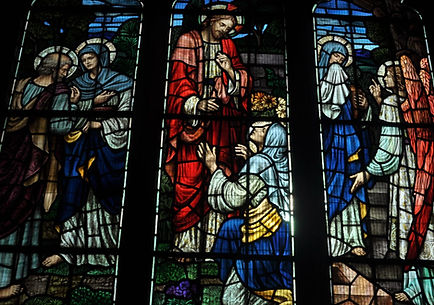
There is not a great deal of stained glass to be seen here, but what there is, is of interest. A three light window in the south aisle concerns Mary Magdalene ay Jesus’ tomb on Easter morning; this taken from John Chapter 20. Starting with the right hand panel as we look at it, an angel of the Lord speaks to Mary ‘“Woman, why are you crying?” “They have taken my Lord away,” she said, “and I don’t know where they have put him. (verse 13) We then switch to the left hand panel, with Mary speaking to an unknown man (with nimbus) ‘At this, she turned around and saw Jesus standing there, but she did not realize that it was Jesus. He asked her, “Woman, why are you crying? Who is it you are looking for?” (verses 14-15). Central we see Mary talking to the risen Christ, dressed in blood red cloak and nimbus; wounds visible on hands ‘ Jesus said to her, “Mary ”She turned toward him and cried out in Aramaic, “Rabboni!” (verse 16 all NIV Translation).

At the east end of the south chapel is a two light depiction of St Peter and St Paul. St Peter is holding the keys to the Kingdom of Heaven whilst St Paul holds a sword point downwards.
A memorial stained glass window in the south aisle is to one William Dales, a pilot who was shot down and killed in 1941. He is depicted, in uniform, with two dogs, one at his side and one at his feet. The face of the pilot is an actual photograph superimposed in to the window; the dog at his feet is thought to be a depiction of his own dog.
Over in the south aisle, hemmed in by chairs, is a recumbent effigy of a lady at prayer; under an ogee headed canopy. This dates from the 14thn century. Close by, a curious bald headed figure looks down on those in the aisle through sightless eyes. An interesting carving on a pier on the south arcade notes, in Latin, that this replacement pier was made in 1380 by Thomas Bate of Corby. William and John left their marks here; with the latter having a date below which is hard to read but may read 1716.


The church grounds are large and have much of interest. I have included photographs from a previous visit, when the day was dull, making it easier to photograph the details on the stones without the glare of the sun. I have already mentioned the Belvoir Angels, but there is more to mention.
There are some finely carved slate gravestones in the grounds here and it is always worth taking a look at the small details. A woman with long flowing robe holds out a banner which points the onlooker towards Hebrew Chapter 11, which extolls the virtues of faith in action. A skull at her feet symbolises death; this to be countered by a serpent holding a flower in its mouth, signifying new life.
Nearby we see the intertwined Christian symbols of cross and anchor. A banner has script which reads ‘Blessed are the dead which die in the Lord’ with this coming from Revelation Chapter 14 verse 13. Only the Belvoir Angel stone to John Pickwell has its own Grade II Listing.


