Come Ye Blessed...
DENTON LINCOLNSHIRE
CHURCH OF ST ANDREW
Church Post Code NG32 1LG
Open to visitors
There were three Vale of Belvoir Angel gravestones recorded here in the Heathcote study. I saw two; the one that I missed apparently being out of the ground and leaning against a wall when they visited in 1976. I revisited and double checked and saw no sign of this third stone.

The second stone recorded here is a double angel stone; with the angels being of a normal design but set out in a 'variant' style.
The two angels are to be found set at an angle top left and right, with their wings framing the top of a roundel in which are the details of the husband and wife who are commemorated here.
Just below the tip of the wing of the angel on the left hand side of the stone as we look at it is an hour glass; the right hand side of the stone is partially obscured by the neighbouring gravestone which has hidden where the possible corresponding crossed bones might have been set.
'Blessed are the dead who die in the Lord' is carved around the top corners of the stone.
This one reads 'Here lyeth interr'd the body of Wilm Leeson who departed this life January 22nd 1700 in the 55 year of his age'
'Also Margret his wife died April ye 25th 1721 ages 62 years'.
'Memento Mori' is carved across the top of the stone to Thomas Read; remember death. The hour glass below also proclaims that Man is mortal and will die. The hour glass is normally used in conjunction with crossed bones but the latter is absent here.
The stone is inscribed 'Here lies the body of Thomas Read who departed this life Nov ye 11th 1720 aged 75 years'
Below, it reads 'All flesh is like the withering hay it springs it grows it fades away'
Whilst not a direct Biblical verse, this may have been inspired by I Peter Chapter 1 verse 24 which says
“For all flesh is as grass, and all the glory of man as the flower of grass. The grass withereth, and the flower thereof falleth away:”

The stone that was recorded in the Heathcote study that I failed to track down was recorded as saying 'Here lyeth the body of Thomas Wollis he died December 26th `1710 in the 37th year of his age'
SOME NOTES FROM MY VISIT
It was early March 2026 and a full day’s churchcrawl starting off in Lincolnshire; crossing the border in to Nottinghamshire later in the day. It was forecast to be a bright and sunny day but we started out from the west of Peterborough in thick fog and by the time that we reached the church of St Andrew at Denton, our third church of the day, the fog had cleared and the sun was on the verge of breaking through.
This was a return trip, having previously visited here whilst staying in digs at Grantham back in December of 2012; a trip where decent light was at a premium. It was dull, dreary and bitterly cold on that initial visit; and not a great deal better on the revisit to be fair, with the sun finally breaking through after I had shot the exterior and was taking a look inside.
Denton is a small, pleasant village in South Kesteven, Lincolnshire which recorded a population of 277 at the time of the 2021 census. The meaning of the word Denton in Old English is ‘Village in the Valley’. There is a great deal of history here, dating back to Roman times and perhaps beyond that; the village was named in the Domesday Book of 1086 but no church or priest was recorded at that time in lands owned by King William.
Grantham is four miles or so away to the north east and Belvoir Castle stands out as a landmark across the fields to the west. The parish stands either side of the A607 which connects Grantham to Melton Mowbray but the village itself can be found to the north of that road, with the church of St Andrew standing to the west of the village.


As was mentioned earlier, there was no church recorded here at the time of the Domesday Survey and it is suggested that the oldest part of the present structure is parts of the north aisle which dates back to the 12th century. The fine five stage west tower is noted as having been built between 1350 and 1400. I would suspect that this is not correct as the country had more to worry about at that time with the Black Death ravaging the country in 1349. The local area was badly affected with Stamford, some 20 miles away to the south seeing a third of the town population die. One study suggests that the tower was started between 1380 and 1400 and that sounds a lot better with the country taking some time to get back on its feet following that pandemic.
The church of St Andrew is built from ironstone with ashlar dressing and consists of west tower, nave with north and south aisles and clerestories, south porch, north chapel and chancel. Taking a look at the church from the south my reaction was that is a church of impressive proportions; especially the tower, a real statement piece; built for the glory of God but also I suspect as a means to ensure that the donors and their families spent reduced time in purgatory after death in those pre Reformation days when the state religion was Catholic.
The church was extended during the late 14th to early 15th century in the perpendicular fashion. The tower is buttressed, battlemented and pinnacled, with stair turret to the south east corner. A frieze consisting of a repeated ‘X’ design runs across the top of the tower on all four sides. A solitary gargoyle looks out from the south west corner. The church clock is attached to the east wall and low down on the south wall we see an empty image niche which would have held a statue prior to the Reformation.


There is a pleasing perpendicular aspect to this church; battlemented through with the clerestory consisting of five two light windows. There are three tall three light windows against the south wall of the chancel; the east window is of four lights. The north chapel is substantial.
There are some fine carvings on the exterior. Grotesque winged creatures flank the porch; in the process of launching itself in to the air. Close by is a figure of a woman with a square headdress, which no doubt someone with a working knowledge of medieval headdresses could date!
A crudely carved bearded male figure looks at visitors entering the church from the south upside down; long hair flowing down. We also see a mouth puller with lichen encrusted eyes and a few carvings of figures with tongues stuck out in gesture of insult.
My favourite though is that of a grotesque beast; just a small figure at the label stop on a south window. This is a figure which has joyfully lifted up both legs, exposing its buttocks. Fortunately this one is not quite as anatomically correct as the one on the tower at Easton on the Hill and was certainly nowhere near as rude as the Sheelagh Na Gig seen the following day at Kilpeck!
There are six bells in the ring here, which were recorded by Thomas North, whose study of the church bells in Lincolnshire was published in 1882. The first of the ring was inscribed as having been recast by Thomas Mears of London in 1839; along with the name of the church warden of the day Richard Burgin.
All of the others were cast by Thomas Hedderly, a founder from Nottingham in 1782. One of these was cast from new with the other four being re-castings of existing bells. Several of these bells have inscribed the names of William Welby and William Gregory Williams, the benefactors who paid for the bells. The third bells of the rings states ‘Four of us were re-cast to sing by friends to country church and King’.
The sixth of the ring is inscribed ‘All ye that hear my mournfull sound repent before you are lay’s in ground’. The situation today is the same as it was at the time of North’s study.
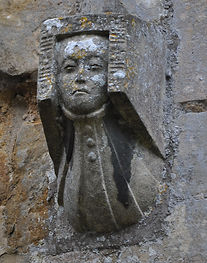

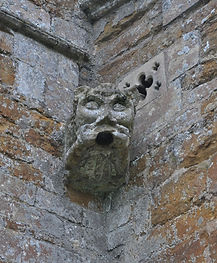

The church here is open to visitors, with entry through the south porch. It was a dull day outside and fairly dark inside as a result but the sun started to find its way through the early morning cloud which improved the light quality.
The arcades date from the early 15th century, with the north arcade being of four bays; albeit with two pier bases dating back to circa 1200. The south bay is of five bays with each having octagonal piers and battlemented capitals which I can’t recall having seen before.
Much to the horror of some I daresay there are comfortable chairs rather than pews; the discomfort inflicted by the latter is not an integral part of Christian worship! Nave is separated from chancel by an oak screen, with entry to the chancel through an ogee headed doorway. High up to the north of the chancel arch is a boarded up doorway which would have led out to the rood loft. Stone heads gaze out across the nave and there was a Christmas tree still set up in the north aisle!
Moving in to the chancel the altar on the day was bare and without cross or other ornamentation; which would have been added before service. There is a fine triple sedilia, the seating for the priests during the Mass, against the south wall, ornately carved and ogee headed. I had a hard time photographing this with the light coming in through the south chancel windows behind it. I tried with my Nikon and also my mobile but results were not good enough to post up on here. The piscina is alongside in its traditional position a little close to the east.
The reredos is a curious thing! It takes the form of a grape vine growing from three pots, all intertwined across the full width and height. The wording ‘The Way The Truth And The Life’ is carved across the front. This is not an understated reredos!


There is a decent amount of stained glass here, with the east window and two others suggested being courtesy of Percy Bacon and Brothers. The east window shows the scene on Easter morning with the three Marys arriving at the tomb to find it empty. They meet two angels in shining garments with script below reading ‘Why seek ye the living among the dead?’ Interestingly this window is faithful to the Gospel of Luke and John, each of which records two angels. The Gospel of Matthew suggests one and angel and the Gospel of Mark states one ‘young man’ dressed in a white robe.
Other windows from this stained glass artist are a three light window depicting Faith Hope and Charity and one further which depicts St Andrew central, after who the church is dedicated; this flanked by St George with red dragon trampled underfoot and St Hugh of Lincoln, who accompanied by a swan, one of his associated symbols.
One three light window shows Jesus central ministering to a crowd. He points up towards Heaven with one hand and down towards hell with the other. The message is obvious; the choice is yours! I always find it interesting to see the expression on the faces of the people in the crowd when Jesus is preaching. Here we see a male figure at prayer with eyes cast up towards Heaven, accepting what he is being told. My attention was taken though by a young female figure holding a baby. She glances across almost furtively at Jesus; she looks tired, bound down with life’s burdens ‘Come unto me, all ye that labour and are heavy laden, and I will give you rest’ Matthew Chapter 11 verse 28.


There is a single window from the Kempe studio which is of three lights. Work from Charles Eamer Kempe, who died in 1907, features his trademark wheatsheaf incorporated somewhere within the design. Here to the left we see Elizabeth with her son John the Baptist, central is Anna who Christian tradition suggests was the mother of Mary the Mother of Jesus. She is depicted teaching Mary her daughter to read. To the right we see the prophetess Anna who was in the Temple when Jesus was presented to Simeon when he was 40 days old.
We also see Jesus, dressed in a symbolically blood red cloak, raising Jairus’ daughter from the dead. The west window has a mixture of Old and New Testament figures with St Andrew with saltire cross easily identifiable; as is St Peter with the keys to the Kingdom of Heaven. St John holds a chalice, out of which emerges a serpent. Christian tradition states that John was given poisoned wine whilst at Ephesus. He prayed over the wine and the poison came out in the form of a serpent. St Paul, as is mostly the case, holds a sword point downwards. From the Old Testament we have Abraham and King David who plays the harp. We also see Zechariah, the father of John the Baptist who swings a censer and Moses who holds a commandment tablet.


In the north aisle is a monument to Richard Welby of Denton Hall, who died in 1714; the monument carved by Thomas Green of Camberwell. He stands under an archway, wearing a long flowing wig, attended by two angels, who place a gilded crown of victory on him. Below are two putti, who are shown in mourning, with one holding a carving of a skull.
Still in the north aisle we see a mid 18th century wall plaque which has a human skull flanked by an ouroboros and an hour glass. The skull, the deaths head, is an often used symbol for the mortality of Man, with the hour glass another symbol of the transitory nature of human life; Tempus Fugit, time flies. The sands of time have run out for the deceased and likewise they will for you. Therefore live a good Christian life, trust in God and do not be caught lacking when your own time comes; as with low life expectancy it might be later that you think!
The ouroboros is a serpent with its tail in its mouth; an often used symbol for eternity. Taken together these symbols tell of the inevitability of death but the reward of eternal life for those who are deemed righteous.
In the south aisle we see the recumbent figure of Johannes Blyth who died in 1602 ages 28 years. His wife, Margaret Thorold and their six children are depicted below.
In the chancel we see a 14th century effigy of a priest at prayer under an ogee headed surround. The names of his six children are carved above their images, with Robert having lost his head at some point back in time. An elaborate epitaph above in Latin has at the apex two female figures that lean against a carving of a skull.


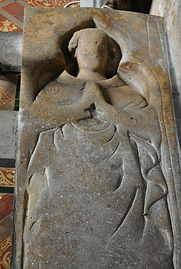

Moving back outside and taking a look around the church grounds I was mostly interested in the two Belvoir Angel gravestones which started this piece. There are some finely crafted slate gravestones, a few of which also show the human skull. One carving of an angel in flight is worth looking at. The angel points upwards towards Heaven and holds a banner on which is inscribed ‘Holy Holy Holy the Lord God of Hosts’ which is part of Isaiah Chapter 6 verse 3, although the gravestones itself records this as verse 6. Underneath this is further script which reads ‘He bringeth down to the grave and he bringeth up’, this being part of Hannah’s prayer from I Samuel Chapter 2 verse 6 which describes God’s absolute sovereignty over death and human circumstances.
No gravestones in the church grounds here have their own listing but the base of a 14tyh century churchyard cross has its own Grade II Listing, as does the churchyard gate and piers to the east of the church.


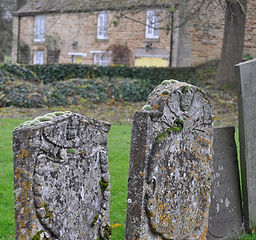
It was time to hit the road, heading off the short distance to the north west, to neighbouring Woolsthorpe. It was good to be back here again; the church at Denton being a favourite of mine and the area as a whole being one that I have grown very fond of over the years. The church of St Andrew is open to visitors as are many of the churches in this area with eight churches visited on the day with all eight being open.