Come Ye Blessed...
SEDGEBROOK LINCOLNSHIRE
Church Post Code NG32 2EU.
Open to visitors
CHURCH OF ST LAWRENCE
There is just a single Vale Of Belvoir Angel standing in the church grounds here. The angel itself is badly damaged; just the tips of the wings remain! The hour glass and crossed bones partially remain.
It is suggested that this might have been the work of someone of a puritan nature who objected to the subject matter on the gravestone.
The stone reads 'Here lye the body of Mary Chamberlin wife of Thomas Chamberlin She departed this life October 27th 1704 and in the 27th year of her age'
Unusually, there is no inscription underneath the details of the deceased.


SOME NOTES FROM MY VISIT
It was lovely to find the church of St Lawrence at Sedgebrook open to visitors during the summer of 2025. I had visited here a couple of times before; firstly on a bitterly cold dull December day in December 2012 when staying in digs at Grantham; the church being closed on that occasion. This was followed by a revisit in the summer of 2020, when covid 19 was hitting the country hard; we were able to travel again after the lifting of the first national lockdown and churches were allowed to be open but in reality very few actually were.
It was third time lucky in August 2025 when the church of St Lawrence was our fourth church of the day in a Lincolnshire churchcrawl that had started off in the South Kesteven district of Lincolnshire, at Great Ponton; then skirting around to the east and south of Grantham; approaching Sedgebrook from the north east from the direction of Belton House.
Sedgebrook can be found alongside the A52 which connects Grantham to Bingham. Grantham is five miles or so away to the east with Bottesford, four miles away to the west. Belvoir Castle is some three and a half miles away across the fields to the south west. The parish recorded a population of 329 at the time of the 2021 census.


There is a very rural feel to the village here; with a long distance shot from the south on a previous visit showing the tower of St Lawrence standing up above various barns and silos from the neighbouring farm; traffic from the A52 in the foreground.
The church of St Lawrence stands to the north of the village; a quiet pleasant scene despite the close proximity of the A52, with the earliest parts of the present structure dating back to the early 13th century. The village was mentioned in the Domesday Survey of 1086 but no church or priest was recorded here at that time.
Close to Sedgebrook to the east was Newbo Abbey, which was founded in 1198 and was one of the first abbeys dissolved by Henry VIII in 1536. Nothing remains of the abbey today but a recumbent effigy of what is thought to be the first abbot, dating from around 1200 was found during excavations and is now in the private chapel at Belvoir Castle.
The structure that we see today consists of west tower, nave with north and south aisles, north and south porches, south chapel with stair turret and chancel. Much of the structure dates from a period of 15th century rebuilding; the earliest surviving part of today’s church is the north arcade which dates back to the early 13th century with the chancel arch dating from the 14th century.
The chancel and south chapel was paid for in 1468 by Sur John Markham of Sedgebrook Hall who was Chief Justice of the King’s Bench. Markham was known as ‘The Upright Judge', who as Chief Justice of the King's Bench challenged the authority of Edward IV, by proclaiming that the King had no power over the judiciary, thereby confirming the role of the monarch as constitutional. He was removed from office and retired to Sedgebrook, living the remainder of his life in a loft above the south chapel. The church was restored in 1897.


Looking at this attractive dressed ironstone church from the south we see the west tower, which is heavily buttressed and battlemented, with church clock in the traditional colours of blue and gold facing out from the south wall. Beast like lichen encrusted gargoyles crouch out from all four corners of the tower; a family of young Rooks perch close by, disinterested in the visitor with the camera.
Moving around there is a fine west door in the tower with shields in the spandrels; two very weathered heads looking out. Both north and south porches are quite plain but there is a holy water stoup built in to the western end of the north porch.
There are no clerestories here but plenty of light enters in with four two light windows in the nave and three two light windows, joined together on the south wall of the south chapel. A stair turret with battlemented top rises up from the west end of the chapel. The east window is of five lights; a few assorted heads peer out at those in the church grounds, which include a Green Man like figure with curiously mismatched eyes and a figure who looks to be wearing armour and has impressive fangs!
When Thomas North saw his study of the church bells in Lincolnshire published in 1882 he noted that there were three bells in the ring here with the first inscribed ‘God Save His Church’ and cast by William Noone of Nottingham in 1724. The other two in the ring are each of great age; dating from around 1500 and cast by Mellours of Nottingham. This would have been Richard if it was cast in 1507 or before and Robert if it was after 1507.
The second of the ring is inscribed ‘PERSONET HEC CELIS DULCISSIMA VOX GABRIELIS’ which translates as ‘May this sweet voice of Gabriel sound through the Heavens’. The third of the ring, North notes, has had an inscription erased. The situation today is exactly the same.


Moving inside, it is bright and welcoming; there are no clerestory windows here to let in extra light and to be fair they were not needed on the day; with the lack of stained glass here helping in that respect.
There are three bay arcades to north and south with the north arcade being the oldest, dating from the early 13th century. This has elegant circular arches, rounded piers and octagonal capitals. The south arcade dates from the 15th century with pointed arches, octagonal piers and capitals. A restored screen separates nave from chancel with a basic cross without figures hangs above the arch. A doorway high up to the north would have led out on to the rood loft.
A further screen, which has a rood loft, separates off the north chapel, which today is used as an organ chamber. A piscina set against the south east wall indicates that the Mass was given out from this side chapel.
Looking at the interior, there is a great deal of history to be seen here; but the hand of the Victorian restorers is very much in evidence throughout.
A two light window and a door on the west wall leads in to the south chapel, which today is used as a museum which details the history of John Markham along with the church and village. Against the south wall of the nave is a doorway which leads in to the stair turret for the south chapel, in which the Sanctus bell still hangs.
Looking to the west the tower arch is tall and slim with a modern screen separating it from the nave. There is no stained glass in the church here at all; not even any reassembled fragments.


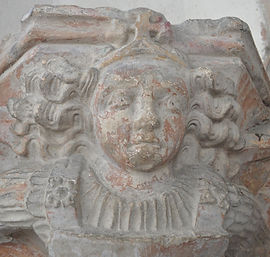
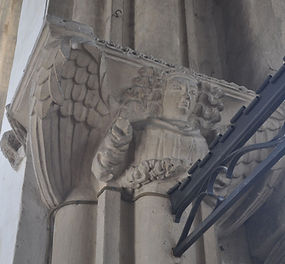
Moving in to the chancel the east window is of five lights and of clear glass. The altar cloth was purple on the day; the liturgical colour used primarily during advent and lent. The reredos is in the form of a gold curtain and the eastern end of the sanctuary is flanked by two ornately carved but empty image niches. The niche to the north is badly damaged but the niche to the south is pretty much intact with a gloriously carved angel with long flowing hair and wings unfurled; still having traces of its original paint, looks out from the foot.
Against the south wall of the chancel, in their traditional positions is the sedilia and piscina. The sedilia were the seating for the priests during the Mass in pre reformation churches. Often there are individual seats, and sometimes they are graduated with the seats rising in height, and spiritual importance, as they progress towards the east, the holiest part of the church. Here we have a plain stone bench under an elaborately carved canopy; seating two priests comfortably or probably three back in the day when people were smaller on the whole.
To the east of the sedilia is the piscina; in which the Holy Vessels used during the Mass would be washed. A two bay arcade leads from the chancel in to the south chapel.



The south chapel itself was fascinating; housing as mentioned earlier, the Markham museum. There used to be a marble altar tomb to Sir John Markham in this chapel but this was destroyed and what is left is the slab from the tomb, which has been stripped of its brasses, which is laid in to the floor of the south chapel against the south wall, on which flowers had been laid.
An intricately carved piscina is set against the south wall; meaning that the Mass was given from three separate altars in this church. It is fascinating to try to think back to how busy these churches must have been throughout the week!
The font here is thought to be Norman, and dating from the 12th century which would mean that it is older than the structure which surrounds it. When I saw the date my initial reaction was to ask if this had come from Newbo Abbey which is an older structure.
The oak pulpit is dated 1634 and there is some fine and unusual benches and stalls with some unusual poppy head carvings which date from the 14th and 15th centuries.


With regards the church ground here, these are of interest with many slate gravestones. With the exception of the Belvoir Angel gravestone which started this piece there is nothing of any great interest or rarity though with nothing in the grounds having its own listing.
It was great to see inside the church here and this one is well worth a visit; with much to see for the interested visitor; with plenty of open churches in the surrounding area for those wishing to make a day of it. We continued our South Kesteven crawl, aiming for a few churches in the Billingborough area that I had not seen inside; before crossing over in to North Kesteven, where it was good to revisit Threekingham after several years. In all we visited 12 churches with 11 being open; a friendly and welcoming area and the best crawl for some time.