Come Ye Blessed...
STONESBY
CHURCH OF ST PETER
Church Post Code LE14 4QE
Open to Visitors
There is just a single Vale Of Belvoir gravestone at the church of St Peter, Stonesby.
To see this one you will have to enter the church itself, which was open to visitors when I was there, with the gravestone being wall mounted in the nave.
This one is a little battered and bruised but someone obviously though it important enough to save and bring inside, which is good.

The grave reads 'Thomas ye son of Tho Sisson by Anne his wife who died May the 15th 1734 he di'd an infant'
The script at the bottom reads 'for of such is the kingdom of heaven' This is from Matthew Chapter 19 verses 14.
The full verse in the King James version of the day reads
'But Jesus said, Suffer little children, and forbid them not, to come unto me: for of such is the kingdom of heaven'
This verse was sometimes by these stonemasons on gravestones for children.
SOME NOTES FROM MY VISIT
It’s odd the little things that stick in the mind from the time spent travelling in between covid restrictions during 2020 and 2021; one of these concerning the church of St Peter at Stonesby. Churches had been allowed to open for private prayer in June 2020 and for public worship with restrictions imposed from July 4th.
I visited Stonesby in October 2020, with the church being open to visitors. On leaving I met two locals, a husband and wife. I can’t remember if they worshiped at the parish church or the Methodist chapel. Whichever it was they told me how delighted they were that they were now able to worship again; with the previous week being the first time that they had attended in person since the first lockdown. How important it was for them to be around people again and how much they had missed it. I thought of them a couple of weeks later when the second national lockdown was announced and it was taken away from them again.
I travel a lot with Gary; he being the driver. Ge is not a Christian and at one time we were both heavily involved in non-league football; he still is. We were chatting on one of our trips out between lockdowns about things and I was trying to tell him how important our churches are to us. I asked him a question; how would he feel if his football club was taken away from him, even for a limited time. The answer he gave was that he would be devastated. Well the same goes for this couple at Stonesby and for thousands of others during those challenging times.


I revisited the church here in early June 2026, on a gloriously warm and sunny Saturday; this being the final church of the day in what was to be a seven church crawl, which started off in the north of Rutland before crossing the border in to Leicestershire. Photographs used here are a mixture from both visits.
Stonesby is a small attractive Leicestershire village which recorded a population of 621 at the time of the 2021 census; this figure including the population of neighbouring Sproxton to the east; the two having formed a joint parish since 1936.
It can be found some seven miles to the north east of Melton Mowbray and 11 miles to the south west of Grantham. The village was mentioned in the Domesday Survey of 1086, with no church or priest recorded in lands owned by Guy of Craon.
The church that we see today is thought to have been built by Monks from nearby Croxton Abbey during the 12th and 13th centuries; and consists of west tower, nave with north and south aisles and clerestories, south porch and chancel.


The oldest part of the present structure is the priest’s door in the south wall of the chancel which dates from that original 12th century structure. Major rebuilding during the 14th century saw the addition of north and south aisles with the west tower added late that century.
The walls were heightened and the clerestory windows were added during the 15th century; with work on the chancel in 1667 recorded by a date plaque. There was restoration here between 1874 and 1875 with the work undertaken by RW Johnson with further restoration in 1890.
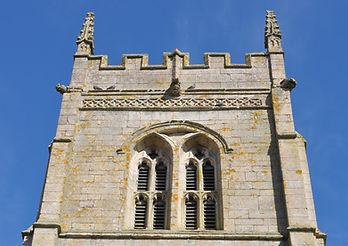
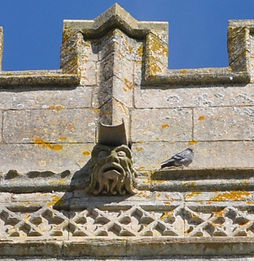
We arrived at the church from the west by foot; with the fine three stage perpendicular west tower looking at its best from that direction. The tower is buttressed and battlemented with crocketed pinnacles to each corner. A frieze runs across the top of the tower with repeated quatrefoil lozenge design.
Gargoyles can be seen central on all four sides of the tower with grotesques at each of the four corners. I suspect that the large number of pigeons gathered around these on this fine and warm Saturday didn’t care about the difference between a gargoyle and a grotesque; with each being an ideal perch!
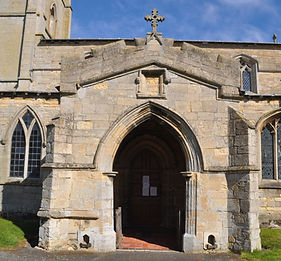
The south porch is battlemented with ancient square recess above the door; two weathered grotesque heads looking out at those approaching from the south.
The clerestory is in the form of three two light windows; the chancel is substantial but a little unusual from the east with the two light east window looking too small for the rest of the wall! The restored priest’s door against the south wall of the chancel has a semi circular arch and a wealth of history!



When Thomas North’s study of the church bells in Leicestershire was published in 1876 he noted that there were three bells in the ring here. The first was cast by Thomas Norris of the Stamford bell foundry in 1626; this being his first year as a founder in what was to be a 52 year career! This bell is inscribed ‘OMNIA FIAT AD GLORIAM DEI’ which translates as ‘Le all things be done for the glory of God’.
The second dates from around 1590; cast by G Lee of Nottingham with this one being inscribed ‘HEC CAMPANA BEATA SACRA TRINITATE FIAT’ which reads ‘May this holy bell be blessed by the Trinity’. The third of the ring has the name John Smith, the church warden of the day along with the name of the founder Thomas Hedderly who cast this in 1761. North notes that this bell had been recast, with the original founder being Tobias Norris III in 1671. The situation today is exactly the same as the time of North’s study.
The church was open to visitors on this revisit; it was bright and welcoming inside, with the sun streaming in through the south windows. The tape that had been there previously to enforce social distancing had long since gone and it was good to be able to wander around freely.


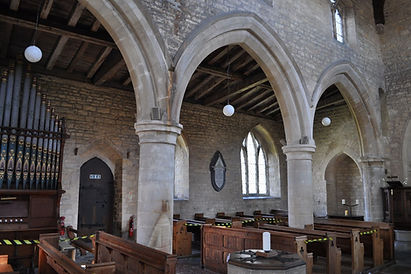
The church was open to visitors on this revisit; it was bright and welcoming inside, with the sun streaming in through the south windows; the tape that was there to help enforce social distancing was long since gone; but I am using interior shots from both visits so there may be a few 'continuity' errors with regards the tape!
Moving inside there are three bay arcades to north and south; with the north arcade having circular piers and capitals, the south arcade being octagonal. Commandment boards hang over the chancel arch and a bricked up archway at the east end of the north aisle indicates that there would have been a north chapel here at one point. Most fixtures and fittings date from the time of the Victorian restoration.
A doorway high up at the east end of the north arcade was the doorway out on to the rood loft. This was a screen which would have separated nave from chancel and an upper part; the rood loft, would have held a carving of the crucifixion; Mary the Mother of Jesus and John standing alongside the cross. These were hated by the reformers; deemed to be idolatrous and were taken down and destroyed as religious beliefs were overturned over a short period of time.
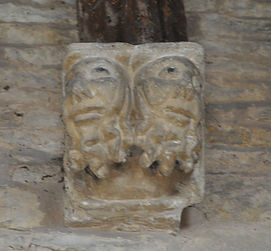
Carvings, for the most part, of grotesque beats look out from the corbels in the nave; with also a Green Man and a veiled female figure. Some 15th century poppy head carvings can be seen on some bench ends in the nave. The font is thought to date back to the 12th century but has been reworked in the past.



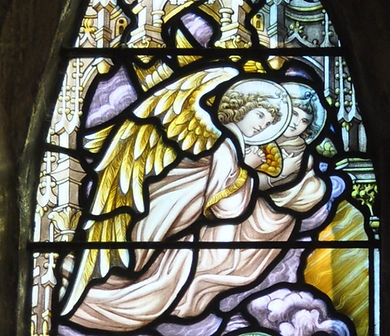
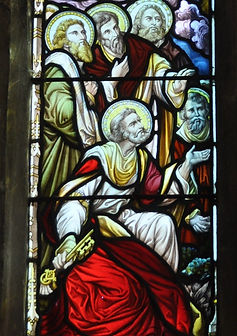
Moving in to the chancel the two light east window depicts the ascension. Jesus rises up, watched by two golden winged angels at prayer. He wears a symbolically blood red cloak, with wounds visible on hands and the one foot that we can see. Below are nine disciples, with two almost totally obscured, with parts of their nimbus visible. Peter is easily identifiable; holding the keys to the Kingdom of Heaven and John is identifiable by his youth.
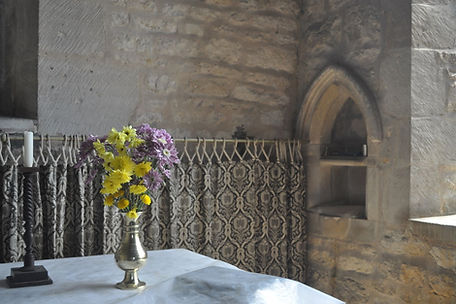
The altar is pretty much like the rest of the chancel; uncluttered, with just a cross and a couple of vases holding flowers. The reredos is in the form of a curtain which stretches the full width of the chancel; the medieval piscina can be seen in its traditional position at the east end of the south wall.
Just to mention again how small the east window is in the chancel; with the window at the east end of the south aisle being far larger. There is also a piscina at the east end of the south aisle, indicating that the Mass would have been given out from here as well. It is amazing to think back to how busy these small village churches would have been at one point’ Given that there would have been a north chapel here, there would have been three altars from which the Mass would have been given.


The only other stained glass her can be found towards the east end of the south wall of the south aisle; a three light window which has Jesus with children central. He holds a small child in his arms with two other slightly older children standing alongside him; all three looking at Jesus intently. This central image is flanked by two other depictions which each state the importance of instilling faith in God in to a child.
To the left as we look at it we see Hannah presenting Samuel to Eli in the Temple. Hannah had prayed to God for a son and promised that if she were given a son she would give him back for service to God.
To the right we see Timothy, Paul’s trusted travelling companion, as a child being taught ny two women. In 2 Timothy, Paul’s second letter to Timothy, he speaks of the importance of the faith that was instilled in Timothy at an early age by his mother Eunice and grandmother Lois.



The church grounds are of interest with a large number of slate gravestones, as you would expect from this area; but nothing in the grounds here has its own listing. On one finely carved slate gravestone we see a carving of a human skull; the deaths head; reminding the onlooker that Man is mortal and will die. The skull is flanked by Christian symbols of Cross and Anchor with script below reading ‘Be thou faithful unto death and I will give thee a crown of life’; this coming from Revelation Chapter 2 verse 10.
Close by we see script at the top of a gravestone which simply reads ‘Faith Hope and Charity’, this referring to I Corinthians Chapter 13 verse 13. In some modern translations of the Bible the word ‘Charity’ has been replaced by ‘love’ with the full verse in the NIV Translation in the NIV Translation reading ‘And now these three remain faith hope and love but the greatest of these is love’.
A finely carved gravestone in slate shows at figure at prayer; holding close to the cross! Script below reads ‘The righteous have hope in their death’. This appears to be based on Proverbs Chapter 14 verse 32 which reads, in the old King James version, which reads ‘The wicked is driven away in his wickedness, but the righteous hath hope in his death’.
An interesting epitaph to one Grace, the relict of John Wright, who passed away aged 80 in 1857 reads ‘Why do you mourn departed friends/Or shake at death alarms/Tis but the voice that Jesus sends/To call them to his arms’.


I tend to enjoy the vast majority of the places that I visit; I am not here to pick holes in things and places but to enjoy the churches and the travelling. Some places are very easy to like though and this is one of them; bit in terms of the church and the village. With regards the church; its doors are open; an important Christian witness! If people walk past them then that is fine but they are open if someone needs; a little peace and calm when it sometimes seems as if the world is going crazy!
There are no bells and whistles here; no worship bands, no massive sound systems; no need! What is here is more than enough; the church serving its community quietly and peacefully just by being there and by being accessible.
Well that was it for the day. Seven churches visited with all seven being open. We took a long circuitous route home, enjoying the villages and the scenery on what had turned in to a very pleasant late afternoon. This had been a good crawl!