Come Ye Blessed...
BOTTESFORD
CHURCH OF ST MARY

Church Post Code NG13 0DA
Open to visitors
There is a single Belvoir Angel stone to be found in the large and interesting church grounds; at this wonderful church.
'Memento Mori', remember death, is carved in to this one, along with the hour glass and crossed bones. The angel here looks sad.
The stone reads 'Here lies interr'd the body of William Fox who departed this life April 12th 1719 aged 40 years'
There is no inscription lower down on this one.
SOME NOTES FROM MY VISIT


I made two visits to the church of St Mary at Bottesford; the first on a bitterly cold day in early December 2012, with a return visit in late June 2020. The church was open on each occasion; the return visit coming shortly after churches were allowed to be open after the lifting of the first covid lockdown, with the south aisle only being open on that day.
This is a church of impressive dimensions with the spire standing at 210 feet; making this one of the tallest spires in any parish church in England. The church dominates the landscape accordingly.
Bottesford is a large village which recorded a population of 3046 at the time of the census of 2021, making this the largest village to be found within the Vale of Belvoir. Bottesford is set alongside the busy A52 which connects Grantham to Nottingham; with Grantham some seven miles away to the east and the centre of Nottingham around 17 miles away to the west.
We are in Leicestershire but close to the Lincolnshire and Nottinghamshire borders; Belvoir Castle is not too far away across the fields to the south.
On that cold December morning I arrived at the church an hour after seeing my first Belvoir Angel gravestone at Muston, a short distance away to the south east. At Bottesford there was another; my love for these gravestones ignited on that cold December morning. A man leaving the church told me that there was a wedding taking place later that morning, but the church was open to visitors and it was fine to look around.


There was a church and priest mentioned here at the time of the Domesday Survey in 1086 in lands owned by Robert of Tosny. Nothing remains of that early structure with the oldest surviving parts of the present church being arches and nailhead decoration in the chancel dating from the 12th century.
This early church would have been rebuilt and extended during the 14th century and again during the 15th century, with the church being rebuilt in the perpendicular fashion. There was much restoration here during the Victorian era with the church found to be very decayed in the 1840’s and the tower was found to be cracked and unstable in the early 1860’s; the tower being shored up and saved from collapse under the guidance of George Gilbert Scott in 1876.
The church that we see today consists of west tower with spire, nave with north and south aisles and clerestories, south porch, north and south transepts, north vestry and chancel.
Taking a look around the exterior the tower and spire obviously dominate. The tower is externally of six stages; each divided by a string course, and is battlemented with a finial to each corner. Gargoyles look out from all four sides. The crocketed octagonal spire rises up a further 123 feet; a real statement piece, built to the glory of God but with also more than half an eye towards reducing time that the donor and their families were to spend in purgatory after death in those pre reformation days. The families in question here being the de Albini family followed by the de Roos; the coats of arms of the latter to be found above the west door of the tower.


Entry is through the south porch and this is a double decker with room above, which would have at one point acted as a priest’s room. A bricked in doorway against the west wall indicates that there would have been steps here at one point to that upper room.
There are clerestories in both nave and chancel. The 15th century nave clerestory consists of 11 three light windows with a clerestory to the chancel being added during the 16th century. A frieze of a repeated quatrefoil design, with some having a central shield, runs across the clerestory and south transept; crocketed finials running the length of the clerestory. The north side of the church is a little less decorated.
There are some fine gargoyles and grotesques to be seen here, with note particularly of two very large figures to the south; with a man ringing a bell and an alewife, a term given to a woman who brewed and sole ale. We also see a depiction of a King and a stern faced prophet, along with a dragon like creature, with bulging eyes, looking a little worse for ware!
Moving around to the east we can see the outline of a previous roofline against the east wall of the nave. When taking a look at the exterior, it is worth noting that the chancel that we see today was the original nave, with the church extending to the west over the centuries.


When Thomas North saw his study of church bells in Leicestershire published in 1876 there were six bells in the ring here, with details as follows. The first of the ring was cast by John Briant of Hertford in 1810. The second was cast in 1713 by Abraham Rudhall, a founder from Gloucester, with this inscribed ‘Peace and Good Neighbourhood’. Strange to see a bell from this far away given that there were foundries far closer to home.
The third was cast by Henry II Oldfield of Nottingham in 1615. This has the Latin inscription ‘CAELORUM CHRISTE PLACEAT TIBI REX SONUS ISTE’ which translates as ‘May my sound be pleasing to thee O Christ King of Heaven’. The fourth is of real age, cast around 1480 in London and having the Brede Mark. This one is inscribed ‘IN MULTIS ANNIS RESONAT CAMPANA JOHANNIS’ which translates as ‘My sound is produced by John’.
The fifth bell of the ring was not ascribed to a founder in North’s study and a quick check on the National Church Bell Database shows that this bell was recast by Taylor of Loughborough in 1903. This bore the inscription before recasting of ‘MISSI DE CAELIS HABEO NOMEN GABRIELIS’ which read ‘I have the name of Gabriel sent from Heaven’.
The sixth and final of the ring is another from John Briant, this one dated 1809 and inscribed with the name of the vicar of the day J Thornton along with church wardens J Vincent and Jno Derry.
The situation now is that there is a ring of eight bells with the extra two, the new first and second of the ring, being added by Taylor of Loughborough in 1903.
Moving inside, it was bright welcoming inside; the visitor’s attention being immediately taken by the sheer number of monuments in the chancel. There are four bay arcades to north and south, with octagonal piers and moulded polygonal capitals.


At ground level, to the north of the chancel arch we see the doorway that led to the stairs leading to the rood loft, with the door leading out on to the rood loft higher up. This would have led to the rood itself; a carving of the crucifixion with Mary the mother of Jesus and John alongside the cross. These were deemed as idolatrous during the reformation; with the thought being that people were worshiping the image rather than God himself’; taken down and destroyed by the Act of Uniformity of 1549 which legislated against superstitious images.
The chancel arch was raised at one point and the Royal Coat of Arms of Queen Victoria sits over the top, flanked by the very faded and indistinct remains of a Doom painting; which would have depicted graphically the scene on the Day of Judgement when the righteous would be taken off to safety whilst those judged to be condemned were taken by demons, naked and chained, to be thrown in to the fiery pits of hell; which was often symbolised by a giant serpent’s mouth.
Moving in to the chancel The five light east window is vibrant in colour and depicts the ascension; with the risen Christ rising up above the 11 remaining disciples, flanked by angels who hold banners on which is script from Acts Chapter 1 verse 11 which reads ‘Men of Galilee why do you stand looking in to Heaven’. Surrounding this central image are four single panel depictions; with to the left as we look at it we have the baptism of Jesus and Jesus presented to Simeon in the Temple. To the right we have the Risen Christ appearing to Mary Magdalene outside the empty tomb on Easter morning along with Christ eating with the two that he met on the road to Emmaus.


A three light window against the south wall of the chancel is by Herbert Bryans, dated to 1887. Central we see a shortened version of the parable of the wise and foolish virgins from Matthew Chapter 25. This parable shows the wisdom of being spiritually prepared for the return of Jesus. Instead of five wise and five foolish virgins there is just one of each. They are each waiting for the return of the bridegroom (Jesus). The foolish virgin has run out of oil for her lamp and is unprepared for his return. The wise virgin has oil for her lamp and was prepared; rising up she meets him.
There are windows from Kempe in the south transept, including an exquisite depiction of the nativity. The wise men have arrived and the scene is watched by an angelic choir. Most of the glass here is Victorian but there are some medieval fragments in a clerestory window against the south wall of the chancel; a glimpse of what things must have been like before the reformation when the church here would have had medieval glass; with in amongst the reassembled fragments is a king and a monk.


As mentioned earlier, the chancel is filled with memorials to the de Roos and Manners families. Central in the chancel, pointing directly towards the east window, is a memorial to Henry Manners, 2nd Earl of Rutland and his wife Countess Margaret. He died in 1563, she three years previously; they lay side by side with hands raised in prayer underneath a table which is crafted to look like a communion table. Their three children are on top of the table at prayer. Henry holds a prayer book in one hand, which has the name Thom Asa scratched in to it.
To the west of the priest’s door is an effigy of a woman at prayer, dating to around 1310. This was brought here after the dissolution of Belvoir Priory and at one point sat in the church grounds before being brought inside.
To the south of the high altar is a recumbent effigy of a knight, this being William de Roos, 7th Baron who died in 1414. To the north of the altar is the memorial to his brother John, 8th Baron who was killed in the battle of Beauge in 1421. Both memorials show the deceased dressed in armour, hands raised in prayer. There is some graffiti on the monument to John with names and dates including Jo Bli who carved their name in 1613.


Memorial to Henry Manners 2nd Earl of Rutland (d1563) and wife Countess Margaret (d1560)

Tomb to William de Roos 7th Baron (d1414)

Tomb to John de Roos 8th Baron (d1421)
A monument to Francis Manners, 6th Earl of Rutland, who died in December 1632, is of particular interest; being known as the ‘Witchcraft Tomb’. The Earl is shown between his two wives, Frances and Cecelia, all three recumbent with hands raised in prayer. At their feet we see two young children who carry skulls; this symbolic of them having predeceased at least one of their parents.
The story is that Frances, his first wife had died and he married Cecelia, by whom he had two sons, Henry and Francis. Employed at Belvoir Castle were Joan Flowers and her daughters Margaret and Philippa, who were dismissed on suspicion of theft. Shortly afterwards the family was taken ill with Henry passing away shortly afterwards; his brother dying in 1620 after a period of repeated illness. Witchcraft was suspected and the three women were arrested and sent to Lincoln prison. Joan died before trial but her daughters were tried; found guilty and hung.
Part of the epitaph on this tomb reads ‘In 1608 he married Lady Cecelia Hungerford by whom he had two sons, both of whom died in their infancy by wicked practice and sorcerye’.


Memorial to Francis Manners 6th Ear of Rutland (d 1632) and his wives Frances and Cecelia. Also in memory of sons Henry and Francis. This is the 'Witchcraft Tomb'
Central at the east of the chancel is a fine alabaster chest tomb to Thomas Manners, 1st Earl of Rutland who died in 1543. He was a great favourite of Henry VIII and was at the coronation of Queen Anne Boleyn and later took part in her trial,
Manners lays at the side of his wife Countess Eleanor who died in 1551, both having hands raised in prayer. They lay facing the high altar; he is dressed in full armour over which is the mantle of the Order of the Garter, his feet rest on a unicorn, of which the horn is missing; her feet rest on a Griffon. At the side of the tomb are weepers, all of which are at prayer. These are probably their children with them having five sons and six daughters.


Memorial to Thomas Manners 1st Earl of Rutland (d 1543) and his wife Eleanor (d 1551)
Richly canopied monuments to the 3rd and 4th Earls were carved in 1591 by Flemish sculptor Gerard Johanssen, with each of the brothers passing away within ten months of each other. Edward Manners was the 3rd Earl who died in 1587; depicted alongside his wife Isabel. He also wears the Order of the Garter over his armour. Isabel wears a ruff and has her only daughter Elizabeth kneeling at the feet. The latter has an interesting and sad story; being married at the age of 13 to William Cecil, grandson of Lord Burleigh, bearing a child and passing away at the age of 15.
Close by is the monument to his brother John, 4th Earl, who died in 1588 at the age of 36 years. His wife Elizabeth lays alongside; again with hands raised in prayer. Their children are at prayer on and at the side of the monument. The epitaph reads that they had five sons and four daughters with one of each dying in infancy and one daughter Frances being born after her father’s death. Interestingly Elizabeth lived until 1594 and was able to see her own depiction on her husbands monument!

Elizabeth Cecil Manners on the monument to the 3rd Earl


Monument to John the 4th Earl of Rutland (d 1588) with his wife Countess Elizabeth (d 1594
Against the north wall of the chancel, close to the altar rails in a monument to the 5th Earl, Roger Manners and his wife Countess Elizabeth. This was made by Nicholas the son of Gerard Johanssen at a cost of £150 including transport. He died in 1612 aged 35 years; there are conflicting dates as to the death of Elizabeth. The church guide suggests that she died in the same year as her husband but one family history site suggest that she died possibly as late as 1615. They married when Elizabeth was 13 years old and they were childless at the time of Roger’s death.
The monument shows both recumbent under an elaborate canopy, as the norm, with hands raised in prayer. Interestingly he is depicted higher than his wife; both heads rest on pillows, he wears an ermine mantle over armour with his wide sporting a long flowing gown with ruff. A headless peacock is to be seen at Roger’s feet with an animal of indeterminate species (to put in kindly) as the feet of Elizabeth.
To the west of this monument is a small effigy to Robert de Roos, 1st Baron de Ros, whose effigy was brought here from Croxton Abbey on the dissolution of the monasteries. An inscription reads that his heart was buried at Croxton upon his death in 1285.


Monument to Roger Manners, 5th Earl of Rutland (d 1612) and his wife Countess Elizabeth (d c1612). Above right is the animal that is to be found at her feet. The church guide describes this as looking like a porcupine which has lost its quills!
Monuments to the 7th and 8th Earls were each made together in 1786 for a combined cost of £100 and are different in style, being sculpted in a Romanesque fashion. George Manners, the 7th Earl, who died in 1641, stands erect in Roman dress, and stands alone with his wife Countess Frances left off the monument. She was the sister of Royalist poet Viscount Falkland and her marriage to the 7th Earl ended childless. Perhaps either of these led to her being omitted from the monument when it was made some 45 years following his death.
The monument to John Manners the 8th Earl is similar but with his wife, also called Frances, included! They each stand, again dressed in Romanesque dress, each flanking an urn with a human skull below looking out at those looking in reminding them of the fragility of human life and the inevitability of death. Above two putti sit alongside the family coat of arms.


Monument to John Manners 8th Earl of Rutland (d 1679) and Countess Frances (d 1671)


There is nothing with its own Grade II Listing in the church grounds except an early 18th century chest tomb. The grounds are very large and a comprehensive listing of the gravestones undertaken some years back recorded well over 1000 stones.
The oldest legible gravestone here is to Tho Parker who died in 1669. There is nothing identifying how old he was when he died but if he had lived to be in his 30’s he would have lived through the English Civil War and the Bubonic Plague decimating the country.
As we see time and time again life was often short and hard. Next to the Belvoir Angel stone we see a stone to Mary Cragg the daughter of Daniel and Mary Cragg who died in November 1783 aged 22 years. The infant mortality rate was very high, but there were also a high number of people who survived childhood but died very young.
A stone to Margaret Streeton who died in 1774 aged 31 years has an epitaph which reads ‘ All you who come to view this stone/Pray think how quickly I was gone/Death does not always warning give/Therefore be careful how you live’.
The inevitability of death was pointed out time and time again. An epitaph on a gravestone to Will Vincent who died in 1723 aged 55 years sums this up ‘Remember Man as thou pass by/As thou art now so once was I/As I am now so must thee be/Therefor prepare to follow me’.


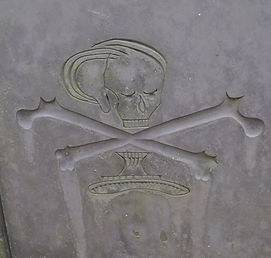
The gravestones also pass on a message by the use of symbols as well as well as script. A description of a solemn looking human skull is a deaths head; a symbol of the mortality of Man with crossed bones beneath also being a symbol of mortality. The message is the same; be prepared for your own passing; and in days of low life expectancy it could be later than you think.
The hour glass is another symbol of mortality; ‘Tempus Fugit’ time flies and the sands of time have run out for the deceased. Here though we see this connected to the faith of the deceased by having an Ouroboros, a serpent with its tail in its mouth, wrapped around the glass. This was an often used symbol for eternity with the inference here being that the deceased had lived a good life and had won the reward of eternal life.
There is more spiritual symbolism on a gravestone which shows an angel in flight blowing a trumpet. The trumpet was a symbol of the resurrection; on the day that Christ returns. I Corinthians Chapter 15 verse 52 reads ‘in a flash, in the twinkling of an eye, at the last trumpet. For the trumpet will sound, the dead will be raised imperishable, and we will be changed’. Part of this verse is included on a banner which is held by the angel. Again, this can be seen as a testament as to the faith of the deceased.
This is a superb church with much of interest and is an absolute must visit if you are in the area. Allow plenty of time though as there is much to see! The welcome received when visiting was absolutely first rate as well! If you are in the area there are plenty of churches close by that are normally open to visitors. On a brief re-visit in the early spring of 2026 I had visited Grantham, Harlaxton and Denton prior to visiting Bottesford; with all being open. After leaving Bottesford we visited Woolsthorpe, Claypole and Newark with again all being open.