Come Ye Blessed...
MELTON MOWBRAY
CHURCH OF ST MARY
Church Post Code LE13 1AJ
Open to Visitors - but limited hours Check church website for opening times.
There were two Vale of Belvoir Angel stones recorded here in the Heathcote study. One of these is the earliest dated surviving stones. The church grounds here are of great interest; with the church itself being the largest, and one of the finest in Leicestershire.
I will start with the oldest first, with the gravestone to Felmonger Arnold Hytch dating from the late 17tyh century. Hytch himself passed away in 1681 but other family members are also marked here, with one passing away in 1696.so possibly this stone dates from the latter?
The skull and hour glass are present, with some very faded text across the top reads, or read as parts are now missing, 'Blessed are ye dead which die in ye Lord'. This comes from Revelation Chapter 14 verse 13.
The angel itself is a curious thing with a very small head in relation to the size of the wings compared to others that we see.
This stone reads 'Arnold Hytch felmonger died August 3 81 aged 55. Also John Green carpenter died September 2 89 aged 40 Also Magdalen wife of Aorold Hytch died September 7 1696 aged 62 Also the children of John Green are here deceased Mary Anne also John and Thomas all these lie buried near this stone'
A fellmonger, by the way, is a trader in animal hides or skins.

The second of the two dates from 1707 and again the hour glass and crossed bones are present.
This stone is inscribed 'Here lyeth the body of Mary Gascoigne relict of Simon Gascoigne of Herlaxton (Harlaxton) in the county of Lincoln who departed this life November 9th Anno Sahitis 1707 aetais suae (of his age) 86'
Mary lived to an advanced age for those times when life expectancy was somewhere around the early 40's. She would have been born in the early 1620's. Amazing to think that we are looking at a gravestone here from someone who was a young lady when the English Civil War was raging throughout the country and who would have been in her 40's as the Bubonic Plague struck. What stories she could tell...

Some Notes From My Visit.
It was mid April 2026, and a return visit to the church of St Mary at Melton Mowbray. I had visited a few times here over the years; but hadn’t been back since the summer of 2016, when staying for a few days at Long Clawson. It was good to see the church here again; and it was good to make use of the Rutlander bus, the old Rutland Flyer for those who know their buses! It was an enjoyable hour or so travelling in from Corby; the rolling Rutland countryside chequered with yellow field of oilseed rape and newly born lambs in large numbers!
At the risk of sounding even more boring than you suspect that I am; there are fond memories of happy churchcrawling trip out on the old Kimes Bus number seven which ran from Peterborough to Nottingham, stopping in Melton en route. This route was taken over by Centre Bus and then was sadly discontinued; another example of routes that have been reduced or cut since I started the hobby 20 odd years ago.


Melton Mowbray can be found on the A606 which runs out of Oakham and through Melton in the direction of Nottingham; which recorded a population of 27,737 at the time of the census of 2021. There is history here dating back to Roman times with the town being situated close to the Fosse Way, the Roman Road which connected Exeter to Lincoln.
The town is known as the Great Britain Rural Capital of Food; being home of the Melton Mowbray pork pie; with a pork pie shop a little way away to the west of the church and is one of six places that are allowed to manufacture Stilton cheese.
The town was mentioned in the Domesday Survey of 1086 in lands owned by Geoffrey of la Guerche, with two priests but curiously no church recorded here at that time.
The church of St Mary sits central, at the side of the A606, with the Anne of Cleves public house as its neighbour. This 14th century house has a great history; being gifted to Anne, who was for six months was the fourth wife of Henry VIII, as part of their divorce settlement. It is thought though that she never lived there herself.
The house was also gifted to Thomas Cromwell, who was the Lord Chancellor to King Henry VIII between 1534 and 1540, as a reward for his help in church reforms; the same King having Cromwell executed for heresy and treason in 1540. The house itself was built in 1384 to house 14 chantry priests and later served as a priest’s house.


The church of St Mary is considered the finest in Leicestershire and in terms of size it is said to be larger than Leicester Cathedral. Built in cruciform style with a 100 foot central crossing tower, the oldest parts of the structure that we see today are the lower parts of the tower which date to around 1170.
The bulk of the present church dates from the 13th to 15th centuries with the initial basic structure being enlarged with aisles and impressive transepts added during that period, along with the tower being heightened and clerestories added. This is a hugely impressive church; built for the glory of God at a time when the area was prosperous but also built to lessen the time that the donors and their families were to spend in purgatory in those pre Reformation days when the state religion was Catholic.
There was extensive restoration here under St George Gilbert Scott between 1865 and 1869, at which point the nave, aisles and transepts were restored. In more recent times, in 2017 and 2018 the floor was re-laid with underfloor heating.
The church that we see today consists of central crossing tower, nave with north and south aisles and north and south transepts, west porch, north vestry and chancel. Taking a look at the exterior before moving inside the visitor sees a wall of clear glass high up with 12 three light windows to north and south in the nave clerestory, a symbolic number perhaps symbolising the 12 disciples, along with six three light windows to east and west in each of the north and south transepts.

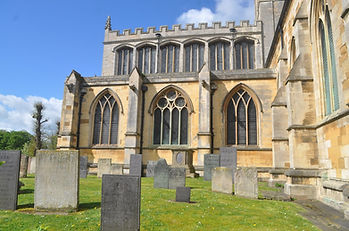
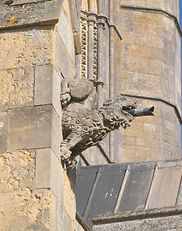
The west end is impressive, with fine five light west window with intricate tracery which is flanked by small empty image niches, which would have held statues prior to the reformation.
The visitor enters in through the west porch, which is also flanked by two sets of empty image niches, perpendicular in style with the two larger niches central, flanked by the smaller.
The ornate central tower rises up buttressed and battlemented, with crocketed pinnacles central and at each corner. A frieze of a repeated quatre foil design runs across the four faces of the tower, with clock attached to the south face.
A tiny weathered carving in a small quatrefoil recess shows a figure which might be carrying a key; therefore possibly St Peter. To the north side, we see a faded monument to Zach Cawdrey and his wife Ann. He was Vicar here from 1613 until 1659. These were interesting times; comprising the English Civil War and most of the Commonwealth period where England Scotland and Ireland were governed as a republic following the abolition of the monarchy after the English Civil War and the execution of Charles I. Zach died in post in 1659 with Ann passing away in 1637; the memorial has at the top a depiction of a hourglass; designed to point out to the onlooker the fragility of human life. ‘Tempus Fugit’ time flies.
There are ten bells in the ring here, with the oldest being attributed to the Seliok family of Nottingham around 1530. There is also a mid 16th century bell cast by Newcombe of Leicester and two 18th century bells by different members of the Eayre family, working out of different foundries; with Thomas I working out of Kettering and Joseph working out of St Neots.
Thomas North, in his study of the church bells in Leicestershire, which was published in 1876, noted that prior to 1728 there was five in the ring. A sixth was added at that time, with two more being added in 1802, cast by John Briant of Hertford, and two further in 1894 by Taylor of Loughborough,bringing the total to ten. Several of the bells have been recast in the fairly recent past.
North notes several entries in the church wardens accounts; including one which records that bell ringers John Hymnane and Robert Bagworth were paid for ringing the great bell when Hugh Latimer preached there in 1553. Her was a leading figure in the Reformation and was arrested when Queen Mary took the throne, being burned at the stake in October 1555.
North also notes that the ringers were paid a gallon of ale for when the ‘Bycchype’ (Bishop) was here. Bell ringers had a reputation for sometimes less than impeccable behaviour and North notes a local legend which told that the ringers here were less than pleased with the Prince Regent, who was to become George IV; subjecting him to a volley of snowballs when he entered the town!


The church here is open to visitors, but only limited hours and it is worth while checking beforehand if visiting; the church website indicating opening times. There had been changes since my previous visit with underfloor heating being installed and the red carpet which ran the length of the nave and in to the chancel having been taken out since that previous visit.
The attention of the visitor is immediately taken by the amount of stained glass here and also by the fact that the north and south transepts are each aisled. This is common enough in cathedrals but less so in parish churches. A pleasant time was spent taking in the interior, to the sounds of the church organ being played throughout.
There are six bay nave arcades to north and south, with these being built between 1280 and 1330, consisting of quatrefoil piers with moulded capitals. The transept arcades each date from the first half of the 14th century with the style the same as in the nave arcades. . Nave is separated from chancel by an intricately carved oak screen, which was part of the Victorian restoration. It was the case of right place at the right time whilst in the south aisle; with multi coloured patterns from a stained glass window reflected in to a brass cross.


Moving in to the long elegant chancel, this was thoroughly restored by George Gilbert Scott and the hand of the Victorian restorers are very much in evidence. Oak panelling surrounds the chancel on all three sides, including a triple sedilia; the seating for the priests during the Mass in pre reformation churches. All of the oak panelling and seats though date from the Victorian restoration, with a gap in the panelling at the east end of the south wall which still holds at 14th century piscina; in which the holy vessels used during the Mass would be washed. We were in the third week after Easter with an Easter scene still on display against the altar rails to the south. The altar cloth was white, this being the liturgical colour used for the period between Easter and Pentecost.
There is a great deal of stained glass here, of great interest and quality; too much to go in to in detail in a single page so will just take a look at a few.
The fine east window is of five lights and contains scenes depicting Jesus’ parables; this being the work of William Wailes; again dating from the period of Victorian restoration. Some of these are well known such as the Parable of the Sower and The Seed and the Good Samaritan; others less well known. A fine window and an interesting choice for pride of place in the sanctuary!


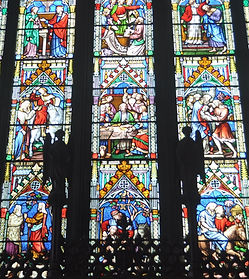
The large five light window in the south wall of the south transept shows scenes from the life of St Paul; with a central depiction of him standing as usual holding a book with sword pointed downwards. Scenes include him as Saul being blinded on the Road to Damascus, more than one shipwreck, appearing before Caesar and finally being beheaded in Rome.
Elsewhere in the south transept we see a three light depiction of the crucifixion by Charles Eamer Kempe, dated to 1901, with the usual subsequent task of finding his traditional wheatsheaf signature.
The north transept is set out with tables; a pleasant place for coffee morning and after service refreshments. Organ pipes are against the east wall, but the organ itself is at the east end of the nave. The five light north window features scenes from the life of Moses; with scenes including Moses being found as a baby, the burning bush (note: sandals off), parting the Red Sea and receiving the Commandments.


On a previous visit here a steward came over as I was looking at the stained glass. She asked me which my favourite stained glass window in the church was; for me it was obvious, the medieval stained glass fragments in the south aisle to which she agreed, perhaps a little surprised. The more modern stained glass here is of great quality and interest; but the history is in the fragments!
The medieval glass fragments were gathered from the church here and others nearby by Dr Thomas Ford in 1820 and reset by Wailes in 1869. We see a depiction of Christ at the top, with other heads including several monks and a rather forlorn looking nun, what looks to be Mary Magdalene in a roundel and a crowned golden haired figure. In amongst the other reassembled jumble of shapes we see a pair of hands at prayer, part of an angel with golden hair spilling down towards a section of wing and a lion like creature with tongue stuck out!


There is much more in the way of glass here, but just to mention a couple of other windows. One four light window in the nave depicts, Boaz, Ruth, who carries the wheat that she has gleaned, Naomi who was Ruth’s mother in ;law and King David. The first three are all found in the Book of Ruth; with Ruth being the Great Grandmother of King David, with all being in the family line of Jesus; there being 28 generations between King David and Jesus.
The other window that I wanted to mention is what is called the Martyrs Window. I mentioned before that Hugh Latimer preached here in 1553. He had local connections and is depicted on a three light window along with Nicholas Ridley and Thomas Cranmer. All three were burned at the stake; Latimer for refusing to renounce his Protestant faith, and the other two for heresy and treason as part of Queen Mary’s campaign to restore the Roman Catholic faith in England.


Also a brief mention for a beautiful two light window which depicts the parable of the Wise and Foolish Virgins, which was not included within the parables of the east window; which tells of being prepared on the day when Christ will return. ) is a teaching by Jesus emphasizing readiness for the kingdom of heaven and his return. Ten bridesmaids wait for a bridegroom, five have oil for their lamps and five do not. When the bridegroom (Christ) is delayed those who have oil are prepared for when he does arrive; the five without oil are unprepared and have the doors locked on them.


There are a few other things of note; which included a beautiful 14th century alabaster memorial in the south transept. This elegant lady is depicted recumbent with hands raised in prayer. Her head rests on a pillow which is being plumped up by two winged attendants.
A grave slab close by with no details on it, shows a Lord and Lady at prayer with four sons and seven daughters all at prayer below,
In the south aisle there is a crusader tomb to Hamon Bellers who died in or around 1303. He lays recumbent in a recess against the south wall, in armour, with intricate chainmail, with sword resting against his left hand side; and helmet attached to the wall beside him at the back of the recess. At his feet lays a floppy eared, sleepy looking dog; a symbol of loyalty.


With regards the church grounds here, I was primarily interested in the two Belvoir Angel gravestones, which are listed at the start of this page. There is nothing of any great rarity here and nothing in the grounds has its own Grade II Listing but a few do have some interesting symbolism, which includes a winged skull emerging from a coffin; the word ‘Resurgam’ carved in to the coffin ‘I will arise’.
Close by there is an hourglass and the gravediggers tools of pick and shovel, each contained within a circle comprised of a serpent with its tail in its mouth. This is an Ouroboros an often used symbol for eternity.
A finely carved slate gravestone shows a book on a plinth; with scythe and winged hourglass to the left and symbols of Christ’s passion to the right, namely cross spear and hyssop stick. ‘Search The Scriptures’ is the instruction to the onlooker.
A reclining female figure holds a book on which is written ‘Watch and pray for ye know not the hour of your master’s coming’ which is exactly the message that the window detailing the Parable of the Wise and Foolish Virgins is telling us.


Well, the church here is a real statement piece! When open the church here is manned with friendly and welcoming stewards and is well worth a visit if you are in the area; allow yourself plenty of time though as there is a great deal to see. Those wishing to make a day of it will find a decent number of open churches; particularly heading south east in to Rutland. Whissendine, some six and a half miles to the south east is a beautiful church and Oakham, 11 miles off in the same direction, is also an open and welcoming church in a lovely town.