Come Ye Blessed...
ASHWELL, RUTLAND
CHURCH OF ST MARY
Church Post Code LE15 7LP
Open to Visitors
The church of St Mary, Ashwell is one of just two churches in Rutland to have a Vale of Belvoir Angel stone, the other being Cottesmore which has two. The Belvoir Angel stone here can be found to the south of the south porch, alongside four interesting mid 17th century gravestones. These five stones are grouped together under a Grade II Listing.


The stone here reads 'Here lies the body of James the son of Tho Sketh by Elizabeth his wife died May 22nd 1717 in the year of his age.
The space to record the age of the deceased is left blank; indicating that this was probably a very young child. This is backed up by the script at the bottom of the gravestone which reads 'short was his race long is his rest God takes them soon whom he loves best'.
The hourglass and crossed bones are included at the top of the gravestone, along with the date of death, 1717 recorded at the top.
SOME NOTES FROM MY VISIT
I miss the Kimes Number 9 bus very much! A strong statement I know but sometimes things have to be said! Back in the day it ran from Peterborough through Stamford, on to Oakham; then Melton Mowbray, finishing its journey in Nottingham. This route ran through Ashwell Village before heading off to Whissendine then crossing into Leicestershire. CentreBus took over, who ran it for a time then sadly it was no more. I spent many pleasant days on this route, visiting Ashwell on a few occasions.
The village here recorded a population of 252 at the time of the 2021 census. There was a World War II army base some two miles south of the village, which was the home of the 82nd United States Airborne Division. The site became the home of Ashwell Prison; even though the site itself is in the parish of Burley. This was badly damaged during a riot in 2009 and closed permanently in 2011. Memories of being on a Rutland churchcrawl that Saturday and seeing a huge plume of smoke rising from the prison as I headed towards Ashwell! The prison was finally closed in 2011 and Oakham Enterprise Park stands there today.
I revisited in May 2026, on a seven church crawl which started in Rutland, at a coffee morning at Thistleton, moving on to Langham, Ashwell and Teigh before crossing in to Leicestershire where we were to spend the first part of the afternoon.


The village was mentioned during the Domesday Survey of 1086; with no church or priest recorded in lands that was owned by Earl Hugh of Chester.
A little internet research indicates that little noteworthy has happened here over the years. There was some excitement here though during the 17th century when Royalist Rector Thomas Mason was ejected from his post in 1644. He was one of a number of Royalist clergy in Rutland, which has been a parliamentary area, who were removed from their posts. He was replaced by Richard Levett, who remained in post until Charles II was restored to the throne in 1660; at which time Mason was reinstated, where he was to remain for 20 years.
The church of St Mary site to the north of the village and consists of west tower, nave with north and south aisles, south porch, north and south chapels, north vestry and chancel. The church dates back to the 12th century with the oldest part of the structure that we see today being the western bay of the north arcade which dates from around 1190.
Much of the present structure dates from the 13th and 14th centuries with the west tower dating from the 14th century, likely built after the Black Death. The church was restored in 1850 by William Butterworth, with work at that time including the rebuilding of the top of the tower, refacing the exterior stonework and refitting the interior with new pews pulpit and screens. The lychgate to the east of the church grounds also dates from this period of restoration.

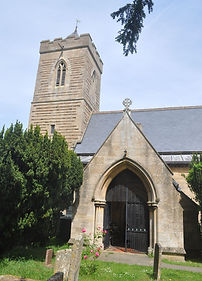

The church here is of fairly basic construction, having never had clerestories, and to be fair it was a little dark inside as a result even on a sunny day, with a decent amount of stained glass inside not helping in that respect. In places the church walls are striped with bands of rubble and ashlar. The 14th century west tower is of three stages with, looking at it from the south, the upper two stages being banded; battlemented with a small pyramid roof.
As mentioned previously there is no clerestory here, with the nave roof being of steeply pitched tile. A beautiful ogee headed priest’s door leads in to the south chapel, weathered grotesque heads at the label ends. The east wall is also banded; the east window is of five lights with intricate tracery.
A serene looking female figure with prominent forehead and slightly irregular nose, peers out through sightless eyes.
This is a church of pleasing proportions; none of the grandeur of neighbouring Whissendine or Langham but very attractive and one that I have become very fond of over the years.
Thomas North looked at the church bells here in preparation for his study of the church bells in Rutland, which was published in 1880. He noted that there were six bells in the ring with details as follows.
The first bell is the most recent cast as part of the restoration of 1850 by Mears of London. This bell is inscribed ‘MISERICORDIAS DOMINI IN ETERNUM CANTABO’ which translates as ‘I will sing of the mercies of the Lord’ which comes from Psalm 89.
The third, fourth and sixth of the ring were each cast in 1708 by William Noone of Nottingham. The sixth of the ring has a lovely inscription which reads ‘HEC CAMPANS SACRA FIAT TRINITATE BEATA’ which translates as ‘May this holy bell be blessed by the Holy Trinity’.
Completing the ring is a single bell cast in 1760 by Thomas I Hedderly of Nottingham and one further from Edward Arnold of Leicester in 1786.
The bells here had been silent since 1976 but were restored and rehung and returned to regular ringing in time for the services at Easter 2024.


The church was open to visitors; as it has been each time that I have visited over the years. The north arcade is of three bays with the most western of these bays having a rounded arch, dating from around 1190; the remaining arches date from the 13th century and have circular piers and capitals with nailhead design on the latter.
The south arcade dates from the first half of the 13th century and is of four bays with octagonal piers and capitals.
Fixtures and fittings date from the Victorian restoration; a red carpet runs the length of the nave and up to the high altar. Arches at the eastern end of the respective aisles leads in to the north and south chapels. Further two bay arcades on either side of the chancel lead in to the north and south chapels.


Moving in to the chancel the altar is plain and simple, with just a cross and two candlesticks with the reredos under the east window having the letters ‘IHC’ and ‘XPC’ two Christograms. There are medieval survivals in the chancel in the form of a triple sedilia, the seating for the priests during the Mass in pre reformation churches with the piscina, in which the holy vessels used during the Mass would have been washed.
There is another survival against the north wall; an empty recess looking to be what is left of an Easter Sepulchre. These are fascinating; in pre reformation days the state religion was catholic. Catholics believed that in the Eucharist Jesus’ bod and blood became physically present in the bread (the host) and the wine. In pre reformation days the host would be wrapped and placed in the Easter Sepulchre, where it would stay until Easter morning when it would be taken out symbolic of Christ emerging from the tomb.
The five light east window is from O’Connor in 1858. It depicts the Transfiguration with Jesus central flanked by Elijah and Moses’ who in turn are flanked by angels who hold banners with Latin text. The first reads ‘Exultate Deo Adjutori Nostro’ which translates as ‘Sing joyfully to God our strength’ which is from Psalm 81 verse 1. The second reads ‘Benedictus Dominus in Aeternum’ which translates as ‘Blessed be the Lord forever’ which comes from Psalm 89 verse 52.
A pyramid of angels can be seen in the tracery, crowned female figures with long golden hair and vibrantly coloured wings. Some are at prayer with others playing instruments.


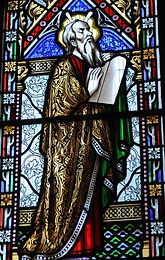


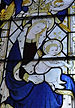
Moving in to the south chapel, against the east wall se see a two light depiction of the annunciation with the Archangel Gabriel appearing to the Virgin Mary. Against the south wall, we see a two light stained glass depiction of the four Gospel writers along with their associated symbols.
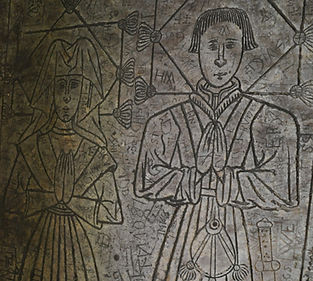
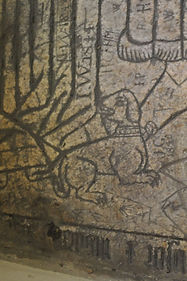
Below this is a 15th century incised slab thought to be in memorial to John and Rose Vernon, who are shown side by side with hands raised in prayer with dog at their feet. The slab is covered with graffiti, mainly just initials and dates but one stood out as being of interest; ‘IM’ leaving his or her mark in 1665, the first year of the Bubonic Plague outbreak that affected the country.
Close by is a recumbent effigy of a cross legged knight, dressed in armour with sword at side. This is thought to date from the early 14th century. The knight’s face is devoid of features and its head rests on two pillows; his feet rest on a lion.
In the north chapel we see an alabaster effigy of a priest, though to be John Vernon with the memorial dating from 1481. The effigy is dressed for Mass; his head resting on two pillows, with what remains of angels at the side of his head. The feet of an animal can be seen at the priest’s feet, the rest of it removed at some point.



Other stained glass here sees a three light window which has the Virgin and Child central; with Mary in her traditional blue, holding the Baby Jesus with two angels with golden wings in the act of crowning her.This central image is flanked by depictions of two of the Virgin Martyrs. We see St Cecelia, the patron Saint of musicians; who as is normally the case, depicted playing a portative, or hand organ. We also see St Agnes, who is shown as usual accompanied by a lamb. Agnes is shown carrying a palm front; a symbol that is associated with the Virgin Martyrs.



The church grounds here are of great interest and as mentioned earlier the fine lychgate to the east of the grounds dates from the Victorian restoration. I was here primarily for the Belvoir Angel gravestone but there is a row of mid 17th century stones, alongside the Belvoir Angel, which caught the eye all of which are in a group Grade II Listing; lichen encrusted and difficult to read, which are some of the earliest that I have seen in this county.
One is of particular interest; just initials which I couldn’t read due to lichen build up but a date of 1666 which was the second year of the Bubonic Plague in this country. There is nothing to suggest that this is the grave of a plague victim but it is always of historic interest to note an important date.
A small stone with the initials ‘FP’ is dated 1656 and from memory I have not seen an earlier dated stone in Rutland. A readable stone to Lettice Coal, the wife of Guy Coal notes that she died in 1670. The stone to her husband has stood alongside for more than 350 years.
Close by a carving of a human skull peers out through cavernous, lichen encrusted eye sockets reminding the onlooker that Man is mortal and will die so live a good Christian life, trust in God and do not be caught lacking when your own time comes. In time where life expectancy was in the 40’s it might be later than you think!
A still moving epitaph to Susanna Harris who died in 1835 aged 71 years reads ‘I was so sore with pain oppress’d/It wore my strength away/And made my long for Heavenly rest/That never will decay’.


It was warm and pleasant in the church grounds; the recent humidity had eased with a band of storms which had swept through the area a couple of days previously. The oxeye daisies were putting on a fine show to the east of the church.There had been a trail of some sorts through the church grounds in the recent past; perhaps a left over from Pentecost? I was very taken with a sign with a bird on it that said simply ‘Serenity’, the state of being calm peaceful and untroubled. My churchcrawls help me aspire towards this state; I liked this sign very much!
It was time to move on, heading the short distance north to neighbouring Teigh. The church of St Mary at Ashwell is open and welcoming and is a must visit if you are in the area. Those churchcrawler wishing to make a day of it will find plenty of open churches in the area to keep them occupied.