Come Ye Blessed...
BURTON OVERY LEICS : CHURCH OF ST ANDREW
Church Post Code LE8 9DB
Open to visitors
Much of my travelling during 2020 and the first part of 2021 was spent in Leicestershire and Nottinghamshire, looking at slate gravestones. The country was suffering greatly with covid 19. Churches were allowed to be open for private prayer from mid June 2020 and open for organised worship from early July. In truth though, few were open!
We travelled when we were allowed to travel and it was an ideal time to concentrate more on the church grounds. We did find a few churches open though; with one of these being the church of St Andrew at Burton Overy.
The village, which recorded a population of 305 at the time of the census of 2021, can be found a little to the north of the A6 which heads from the outskirts of Market Harborough towards Leicester. The centre of Leicester is some eight miles away to the north west with Market Harborough around 12 miles off to the south east. This pleasant Leicestershire village dates back to Saxon times and was mentioned in the Domesday Survey of 1086; and is a little curious in design, long and narrow and pointing off in a north easterly direction! The church of St Andrew can be found to the north of the village, alongside the main road which runs through the village.


On an afternoon of vastly changeable weather conditions these two photographs were taken within ten minutes or so of each other. Another ten minutes after that it was pouring down with rain!
It was an afternoon of contrasting weather; bright sunshine on arrival; cloud building and heavy rain on departure all within the space of half an hour! The church that we see today consists of west tower, nave with north aisle and clerestory, south porch, north chapel and chancel.
The oldest part of the present structure is the tower which dates from the late 13th to early 14th centuries. The rest of the church dates from the 14th to 15th centuries, with the church being restored between 1864 and 1868.
Taking a look at the church from the south the west tower is of three stages. It is battered and bruised with much signs of patching up over the years. There used to be a steeple here with a request made in 1706 to remove the steeple due to its poor condition. This was done, after a wait of more than half a century (no point in rushing), with the tower being repaired at that time. The tower is battlemented with church clock in the traditional colours of blue and gold attached to the south wall. Interestingly the tower here is built without buttresses but at some point it has been tied in with iron bands.
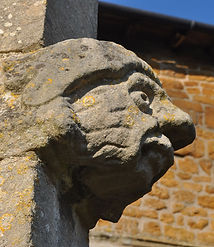
The visitor enters in through the south porch, which has crocketed pinnacles; a grotesque figure looking out from the foot of each.
With no south aisle there is no clerestory to the south; with two tall square headed 14th century windows against the south wall of the nave, with two more continuing on in to the south wall of the chancel. The clerestory to the north is of three small two light windows. To be fair the north side isn’t going to win any architectural awards with more evidence of patching up over the years.


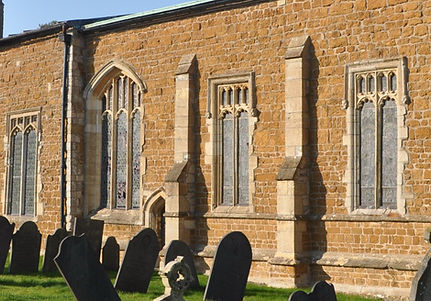
The north chapel dates from the late 15th century; a real statement piece which stands proudly above the roof of the north aisle. This was designed as a chantry chapel with masses being said or sing by paid clergy for the donor and his family to lessen the time that they were to spend in purgatory after death; this being in pre reformation days when the state religion was catholic.
The view of the church from the east is impressive, with a fine five light window at the east end of the chancel with similar north chapel window alongside; each of these being perpendicular in design.
There are three bells in the ring here, which were looked at by Thomas North, whose study of the church bells in Leicestershire was published in 1876. He noted three bells, all of which were cast by Hugh II Watts from his foundry at Leicester.
The first of the ring was cast in 1632 and has the inscription ‘CVM SONO SI NON VIS VENIRE NVNQVAM AD PRECES CUPIES IRE’ which translates as ‘If you are unwilling to come when I call you to prayers you will never desire to go at all’.
The second and third were identical; cast by Watts in 1616 and each inscribed ‘CELORVM CHRSTE PLATIAT TIBI REX SONVS ISTE’ which reads ‘O Christ King of Heaven may this sound be pleasing to thee’. The situation today is the same, with the exception of the third of the ring which was recast by Taylor of Loughborough in 1956.


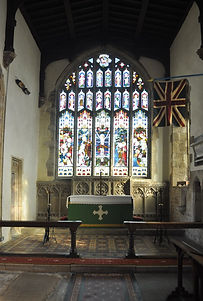
It was a pleasant surprise to see the church open to visitors when so many were closed. Casting a concerned eye at a large and rapidly approaching bank of threatening cloud I popped inside to shoot the interior whilst the light was still good. It was bright and welcoming inside, for the time being at least.
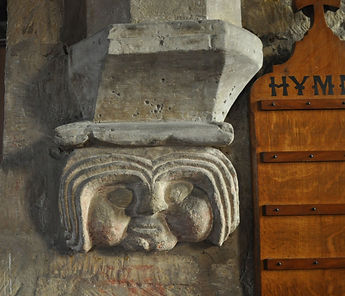
Nave is separated from chancel by a restored screen; there is no chancel arch. The north arcade is of three bays, with double chamfered pointed arches and circular piers; a chubby cheeked human head with centre parting, looks to the west through sightless eyes from the label stop at the eastern end of the most easterly bay. The north arcade runs seamlessly in to the north chapel; looking to the west there is a small tower arch with royal coat of arms above. . At one point there was a gallery inside the church here. This was removed as part of the restoration of the 1860’s; with the work of the restorers visible throughout.


Moving in to the chancel, through a restored ogee headed chancel screen; the altar is plain and simple, with just a cross and a green altar cloth; this being the liturgical colour used for ‘Ordinary Times’ which in this case would be the period between Pentecost and the first Sunday in advent.
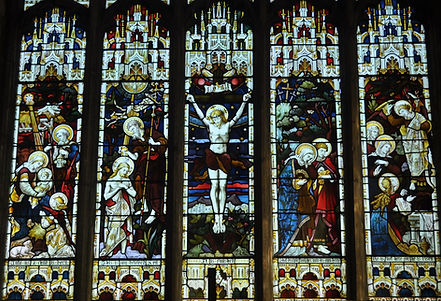
The perpendicular east window is of five lights and has the crucifixion central. To the left as we look at it we see the nativity and the baptism of Jesus. To the right we see John gently leading Mary the Mother of Jesus away from the cross; Mary has head in hands with the Crown of Thorns held in her other hand. To the far right we see the scene on Easter morning with an angel of the Lord appearing to the Three Mary’s; pointing upwards towards Heaven 'He is not here He is risen’.
There is a lot going on in the tracery of this east window. At the top we see the Agnus Dei, the Lamb of God, below this there is a collection of angels, some of whom are playing musical instruments, with others at prayer.
Against the south wall of the chancel we see the medieval sedilia and piscina in their traditional positions. The triple sedilia were the seating for the priests during the Mass in pre reformation churches with the piscina being where the holy vessels used during the Mass were washed. A two bay arcade leads from the chancel in to the north chapel.


Other stained glass in the chancel includes a two light window in which are depicted St Peter, who carries the keys to the Kingdom of Heaven and his brother St Andrew, who carries the saltire cross on which he was later to be martyred.
A three light window has depictions of the nativity and an angel of the Lord appearing to the Three Mary’s on Easter Sunday morning. These are flanked by Jesus surrounded by children and Jesus raising Jairus’ daughter from the dead. The former is interesting. Up in one corner we see what looks to be Peter (due to the lack of hair) seemingly pushing away one of the mothers. This looks to be the scene from Matthew Chapter 19 verse 13 where Jesus rebukes the disciples for attempting to prevent the children from coming to him. Up in the tracery of this window we see angels holding banners; one of which has eyes downturned and arms crossed; holding a palm, a symbol associated with the virgin martyrs. . Alongside, a crowned stern faced angel with vibrant red wings point upwards towards Heaven, with script reading ‘When thou didst overcome the sharpness of death’ this line coming from the Te Deum, an ancient hymn of praise and thanksgiving.


Just a few things to complete this brief look at the interior. The five light perpendicular window in the north chapel is of clear glass, with a medieval piscina close by; this being of no surprise given that this was a chantry chapel. To close, there are many wall plaques and floor slabs here but just to choose one. This is a floor slab to Lady Christian, wife of the wonderfully named Theophilus Burdet, who died in 1681 in her 83rd year. As always, I took a look back to see what events she lived through during her long life.
She would have been a child when the Gunpowder Plot failed in 1603; she lived through the English Civil War and the Commonwealth period where the monarchy was abolished for a time before being restored. She was around during the beheading of a King; lived through the Bubonic Plague and no doubt heard reports of the Great Fire of London.
The circular font dates back to the 13th century and a close look at the beams in the north aisle shows a date of 1636 carved in to it; this possibly being the date that this was reroofed.



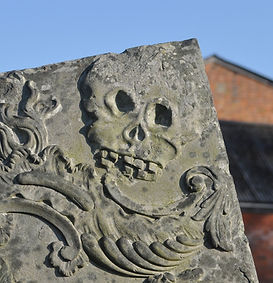
There is much of interest in the church grounds here, and this is one reason why I wanted to include this church on my site. Starting with a very unusual gravestone which tells a very sad tale! The stone itself is of slate and has script, which to be fair is quite hard to decipher, literally covering both sides of the stone. A series of crudely carved images can be seen throughout; which include a grinning skull, a palm front, flowers which include three Tulips, and hour glass, an open book and a spiders’ web.
The stone is in memory of two friends who drowned in an accident in 1721. The script reads as follows…
‘Here lies the bodies of two aged 24 and 22/Thomas Dyer schoolmaster of this place/For pious parts and virtue too/We hope his soul’s at rest and William Simpkins too.
These flowers of youth were swept away/By accident as we may say death met them in the deep and caused us to weep/And here they lie like two who are asleep.
Water is powerful by them is shows/Venture not where you not know/Two brothers like within they lie together liv’d/All you who pass us by/Take care in time prepare to die/On June 20th this accident was done/In one thousand seven hundred and twenty one/Here you see we are born to die/When God sees good we cannot pass it by’.
There are several depictions of skulls on the gravestones; a reminder to the onlooker that Man is mortal and will die. Therefore live a good Christian life, trust in God and do not be caught short when your own time comes. With life expectancy in the 40’s when these stones were carved it might be later that you think! An example here can be seen on a stone to one Elizabeth Lacey who died aged 26 years in 1712.


A stone to one Elizabeth Voss is fascinating! To the left as we look at it there is a human skull with serpent crawling through the eye sockets. Alongside we see the Tree of the Fruit of Knowledge, with serpent wrapped around the trunk. To the right we see Christian symbols, with chalice, cross, hyssop stick, spear, hammer and drops of blood. Central we have Latin script which reads ‘AD ARBOREN ASPICE EN LETHU AD CRUCE ASPICE ECCE SALUTERN’ which translates as ‘Look at the tree in death Look at the cross behold salvation’.
Close by we see a lovely depiction of an angel in flight, blowing a trumpet; the trumpet being an often used symbol of the resurrection. We also see, partially hidden behind a coating of lichen, a serpent with its tail in its mouth, an ouroboros, which was used as a symbol for eternity.
‘Search The Scriptures’ reads script on a plinth, with images of mortality in the form of a scythe and winged hourglass to the left and a cross, spear and hyssop stick; symbols of Christ’s passion, to the right.




I really enjoyed my time here. The church of St Andrew at Burton Overy is well worth taking a look at if you are in the area; open and welcoming with much of interest both inside the church and out in the grounds. It was raining steadily when we left Burton; as we aimed south east in the direction of Church Langton. It was then a case of aiming for the Rutland border and then home to the west of Peterborough by a circuitous route. It was tough times. It was good to be able to travel and it was good to find a church open. A small slice of normality as the world continued to be a hard and depressing place. Thank you for being open!