Come Ye Blessed...
CLAYPOLE LINCOLNSHIRE : CHURCH OF ST ANDREW
Church Post Code NG23 5AD
Open to Visitors


The elegant broach spire of the church of St Peter at Claypole is a familiar landmark to those travelling along the A1 between Grantham and Newark; with the church here being a personal favourite of mine. It was early March 2026 and a revisit to a church and an area that I had a great affection for after previously visiting here back in September 2016.
We had started the revisit in foggy conditions at Grantham and were working our way towards Newark and the Nottinghamshire border with the church of St Peter being the fifth church of the day. The early morning gloom had lifted and the sun was shining brightly as we arrived.
Claypole is a large village which recorded a population of 1352 at the time of the census of 2021. Grantham is to be found 13 miles away to the south east with Newark just over four miles to the North West. The church of St Peter stands at the western edge of the village, alongside the main road, which heads off in the direction of Newark; the River Witham running close by.
The village here was mentioned in the Domesday Survey of 1086; with hands owned by Bishop Odo of Bayeux and Geoffrey Alslein, with a church and a priest recorded in land owned by the latter. Nothing remains of that initial 11th century structure, which is thought to have been a basic wooden building which was replaced by a stone structure, which was extended and developed in to the church that we see today.


The present structure is cruciform in design and consists of west tower with spire, nave with north and south aisles and clerestories, south porch, north and south transepts, north vestry and chancel.
The lower two stages of the west tower were built during the early 13th century with the church at that time being basic in design. During the late 13th to early 14th century a free standing south Lady Chapel was built close to the church by Thomas de Sacto Laudo who was a South Mediety Rector here at the time. Interestingly, the parish at Claypole was divided in to two; a south Mediety and a north Mediety with each having their own Rector; having services at different times from the same church! This was consolidated at some point during the 18th to 19th centuries, with just a single Rector from then on.
A major period of rebuilding during the 14th to 15th centuries saw the nave rebuilt with aisles and transepts added, which included the free standing Lady Chapel incorporated in to the church structure. At that time the tower was heightened, with spire added, the south porch was added; the clerestories and battlements following. The chancel was rebuilt again in 1830 with the church thoroughly restored in 1875.
Going back to the initial September 2016 visit, with external shots used from that visit, it was early in the day; already warm and humid in South Kesteven, with storms forecast throughout the whole of the UK, which were to finally come to fruition a couple of days later. It was quiet and peaceful in the church grounds, despite the close proximity of the main road; on which there was very little traffic.
We see an impressive structure; the four stage tower being battlemented buttressed and pinnacled with a frieze of a repeated ‘X’ design running along all four sides. Curiously there were a large number of pigeons perched on a ledge to the eastern side, but none at all of any of the other sides. Obviously the eastern edge is the place to be!
A recessed, slender elegant octagonal crocketed broach spire rises up; the tip of which looks to have been repaired at some point. The church clock is attached to the east wall, framed by the outline of the previous roofline before the clerestories were added.
The south porch is also ornate; being heavily buttressed, battlemented and pinnacled with a similar frieze design. A large empty image niche stands over the doorway which would have held and image, possibly of St Peter after who the church is dedicated, before the Reformation.


A close look at the south transept shows a bricked in doorway to the western end which would have been the entry point in the days when it was still a free standing structure.
The church here is highly decorated, as is often the case in this area, with carvings of human figures and grotesque beasts looking out from all directions. Gargoyles of high quality look out from the four corners of the tower with the zoom picking out figures on the corbel string high up including a depiction of an owl.
Two grotesques look out across the church grounds from the south porch, with the figure to the west being a woman, rather stern looking and with arms folded, wearing a horned headdress.
On the nave we see a man with what appears to be a drinking horn, a soldier wielding a sword and buckler, a small round shield, a dragon like creature which has its tail in its mouth. It is hard sometimes to figure out what was in the minds of the masons who carved these figure, or in the minds of those who instructed the masons to carve them. Here though there may be a little insight as an ouroboros, a dragon or serpent with its tail in its mouth was an often used symbol for eternity.
We also see a couple embracing, a cuddly rabbit and what looks like a pig in the midst of an emotional crisis. An eclectic mix!
When Thomas North took a look at the church bells in Lincolnshire; with his work being published in 1882, there was five bells in the ring here; with details as follows. He noted that then first of the ring was cast by John Briant of Hertford in 1795; this being the Hertford in Hertfordshire and not the one on the edge of Huntingdon. The same founder also cast the third of the ring that same year, with this inscribed with the names Patman Briggs and William Grimshaw, who were the church wardens of the day.
The other three were each cast by George I Oldfied who worked out of Nottingham. The second of the ring is dated 1633 and had the inscription ‘God Save the Church’ with the fourth which was cast three years earlier having the inscription ‘God Save His Church’. Each of these two bells were recast by Taylor of Loughborough in 1907.
The third of Oldfield’s bells was also dated 1633 and is inscribed ‘All Men That Heare my Mournfull Sound Repent Before You Lye In Ground’ My spellchecker did not care for this inscription!


The church here was open to visitors on each occasion visited. Moving inside it was bright and welcoming inside, with the sun streaming in through the south windows. There are three bay arcades to north and south with a further large bay in to the transepts to the east. The arcades date from around 1300 with clustered piers and foliate capitals, with a Green Man on some of the capitals.
Nave is separated from chancel by a medieval rood screen which dates from the period of 14th century rebuilding and which was restored in 1875. The slender pulpit alongside also dates from the 14th century and was also restored during the Victorian restoration.
Standing at the chancel and looking to the west the visitor can clearly see the outline of the pore clerestory roof line against the west wall of the nave. Moving through the tower arch we see stained glass depictions of Zechariah and Elizabeth, the parents of John the Baptist.
The only other stained glass in the nave is against the north wall with a three light window which shows St Peter central who holds the keys to the Kingdom of Heaven. Above Peter is a cockerel which is in reference to Jesus predicting that Peter would deny knowing him three times by the time that the cock crowed. This central image is flanked by panels showing St Nicholas and St Hugh. The latter was Bishop of Lincoln between 1186 and 1200; and is shown with a swan alongside, which is one of his traditional symbols. Legend states that the swan was a devoted friend and guarded him when he slept; attacking those who came near him


The church here was open to visitors on each occasion visited. Moving inside it was bright and welcoming inside, with the sun streaming in through the south windows. There are three bay arcades to north and south with a further large bay in to the transepts to the east. The arcades date from around 1300 with clustered piers and foliate capitals, with a Green Man on some of the capitals.
Nave is separated from chancel by a medieval rood screen which dates from the period of 14th century rebuilding and which was restored in 1875. The slender pulpit alongside also dates from the 14th century and was also restored during the Victorian restoration.
Standing at the chancel and looking to the west the visitor can clearly see the outline of the pore clerestory roof line against the west wall of the nave. Moving through the tower arch we see stained glass depictions of Zechariah and Elizabeth, the parents of John the Baptist.
The only other stained glass in the nave is against the north wall with a three light window which shows St Peter central who holds the keys to the Kingdom of Heaven. Above Peter is a cockerel which is in reference to Jesus predicting that Peter would deny knowing him three times by the time that the cock crowed. This central image is flanked by panels showing St Nicholas and St Hugh. The latter was Bishop of Lincoln between 1186 and 1200; and is shown with a swan alongside, which is one of his traditional symbols. Legend states that the swan was a devoted friend and guarded him when he slept; attacking those who came near him


Moving in to the chancel, this is of great size and the east window is of four lights with clear glass. Against the south wall is an ornately carved ogee headed treble sedilia with piscina alongside to the east, each of these dating from the 15th century.
On the north while we have what I thought was either an elaborate aumbry, a cupboard in which the holy vessels used during the Mass were stored or a very small Easter Sepulchre, a recess in which the Host, believed to become the real body of Christ in the Catholic faith, is placed on Good Friday to be symbolically removed on Easter Sunday morning. The official listing says Aumbry so am happy to go with that!
There are a few monuments in the chancel in memory of former Vicars. One is to the Revd John Beevor, who was Vicar here for 41 years from 1779 until his death in 1820 at the age of 67 years and his wife Ann who died in 1840 aged 83. A sad aspect to this memorial, and something that was by no means unusual for the time, is that five of his children dies young and are buried close to the chancel with ages from Preston who live for a single day to Margaret who passed away at the age of 20.

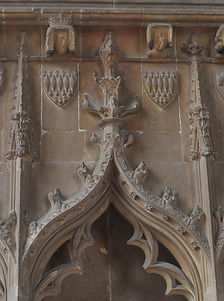


The south transept, which was the 13th century Lady Chapel, has triple sedilia and piscina set in to the south wall, under the south window with piscina alongside, each of these dating to the time that it was built. The sedilia is not the most photogenic to be fair as it houses a notice board!
The four light south window contains eight scenes from the life of St Peter; an interesting series of depiction taken from before and after the crucifixion.
Pre crucifixion we see Peter warming himself by a fire after Jesus’ arrest, ‘I know not the man’ he says on being questioned. One further panel shows Jesus rebuking Peter after Peter rebuked Jesus for predicting his own forthcoming death.
Post crucifixion we see the Risen Christ appearing to Peter and John as they fished; and Peter being reinstated by Christ following his betrayal and being given the Keys to the Kingdom of Heaven.
Leaving the Gospels the final two panels in this series show Peter in Acts. We see a depiction from Acts Chapter 2 verse 38. Peter preaches in Jerusalem where 3,000 were baptised on what was to be called the day of Pentecost ‘Repent and be Baptised’ is in script below. Alongside we see a scene depicted from Acts Chapter 10 verse 34. In this Peter realises after a dream that the Gospel is for everyone and not just the Jews. The script here reads ‘God is no Respecter of Persons’ in the King James Version. It probably reads more clearly in the NIV translation which reads ‘God Does not show Favouritism’.


Scenes from the life of Peter. From left to right, Jesus chastises Peter, Peter attempts to walk on water, Peter warms himself by the fire after denying Jesus on the night of his arrest, the Risen Christ appears to Peter and John.


Scenes from the life of Peter. From left to right The Risen Christ reinstates Peter after he denied knowing him three times on the night of Jesus' arrest. Peter is given the keys to the Kingdom of Heaven. The we have two scenes from Acts, the first showing Peter preaching on the Day of Pentecost.
There is quite a lot of graffiti here with ‘TD’ leaving his or her mark in 1734 with ‘TR’ doing the same four years later. A scratched image of what could be a pheasant stands close to a crudely drawn male and female figure, each having an unfeasibly small waist. We also see the very faded remains of a daisy wheel, also known as a hexafoil, which is like the compass drawn flowers that we made as children. Some suggest that these were an apotropaic symbol, a ritual protection mark, which was carved in to the walls as a protection against evil. . In amongst the other light scratches and scribbles is an arrow pointing downwards I thought might be a mason’s mark; and if that is the case it would date from the time that this stone, and the stones around it obviously, was set in place.
The font, which can be found under the tower arch, is heavily decorated and dates from the 14th century, hexagonal in style with ogee headed arches, with carvings of faces, several of which are damaged, looking out from the label stops.


It was time to hit the road again, heading over to Newark, a short distance away to the north west. This was a new church to me; and a previous attempt to photograph it 18 months or so earlier had proved unsuccessful with the whole tower covered in scaffolding. I have some pleasant memories of my time spent here at this church and it is well worth taking a look at if you are in the area.
There are a decent number of open churches in this area as well; and a visit to the area around Grantham and Newark would prove of interest to a churchcrawler looking to make a day of it.