Come Ye Blessed...
HARLAXTON LINCOLNSHIRE : CHURCH OF ST MARY & ST PETER
Church Post Code NG32 1JQ
Open to Visitors
It was early March 2026 and a full day’s churchcrawl was planned, which started off in Lincolnshire before crossing the border in to Nottinghamshire during the afternoon. We had started off the day at Grantham and the early morning fog had lifted by the time we arrived at the church of St Mary and St Peter at Harlaxton; a dull start to what tuned out to be a day of glorious sunshine later.
The village here can be found some two miles to the south west of Grantham and 12 miles to the north east of Melton Mowbray; recording a population of 841 at the time of the 2021 census. The village was mentioned in the Domesday Survey of 1086, with no church or priest in land that was owned by King William.
To the south east of the village is Harlaxton Manor, which was built between 1831 and 1854, this replacing an earlier mid 14th century manor house on a previous site which was deserted by 1780 and pulled down in 1857. After an interesting history the manor these days acts as a college; the British campus for the American University of Evansville and is affectionately known as Hogwarts locally.


The church of St Mary and St Peter stands central in the village, but with green fields to its south and east; set back from the A607, which connects Grantham to Melton Mowbray, which runs to the north of the village
Built from ironstone and limestone ashlar, the church that we see today consists of west tower with spire, nave with north and south aisles and clerestories, south porch, north and
The original church was built between 1174 and 1185 on land donated by William the Conqueror’s niece Matilda. The oldest part of the present structure is the nave and the north arcade which dates to that original structure, with the south arcade and aisle following between 1175 and 1225.
The lower three stages of the tower were completed by 1325 with the south arcade of the chancel and the south chapel itself, according to the informative church history booklet, dating from 1325 until 1350. I suspect that we can disregard the years 1349 and 1350 though, with the country having more to worry about as the Black Death decimated Europe and beyond.
The tower was completed and the clerestory was added around 1380 with the north arcade of the chancel, the north chapel built between 1420 and 1450, with the north aisle being rebuilt at the same time. A new south porch was built in 1858 and the church was thoroughly restored between 1890 and 1891.


Taking a look at the church from the south we see a square four stage tower which is heavily buttressed battlemented and pinnacled, with the top stage, which as mentioned earlier was a later addition, built purely from ashlar as opposed to the ironstone used on the lower three stages. Gargoyles of high quality look out centrally from the four sides of the tower; smaller grotesque heads can be seen on the frieze which runs around the top of the tower. A recessed crocketed spire rises up, which has a single tier of gabled lucarne windows.
The clerestory takes the form of four two light windows; the east end is impressive, reflecting of the wealth of the manor when building was underway. Chancel runs seamlessly in to north and south chapels, separated only by buttresses; all three under battlements.
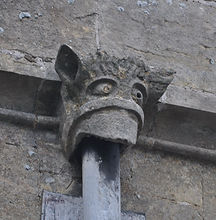
Stone heads peer out from throughout the exterior; including a stern faced gentleman with long hair and impressive beard and moustache who looks on in a slight disapproving manner. We see tethered beasts, mouth pullers and a grinning impish like figure who gleefully holds its legs over its shoulders, exposing itself to anyone who cares to look up and notice. Fortunately, this wasn’t as anatomically correct as some that I have seen over the years and I was to see another in similar vein at neighbouring Denton half an hour or so later.




Whilst taking a look at the exterior, I was diverted for a short time by a beautiful building to the east of the church grounds. Tudor style in design with bell tower and some glorious chimneys; this is the Old School House, which has Grade II Listing; one of no fewer than 79 listed structures in this village.
It was a chilly start to the day on this early March morning; the fog having lifted but winter was unwilling to let go! Meteorological spring had started a few days previously but there was a bite still to the cold. A few late season daffodils were out still; a little colour dotted around on a dull day. It was quiet and peaceful; it was lovely!
Thomas North saw his study of the church bells in Lincolnshire published in 1882; he noted that there were five bells in the ring here, with details as follows. The first and fifth of the ring were each cast by Robert Taylor of St Neots in 1820. The first was inscribed ‘The Gift of Geo: Ligne Gregory Esq Lord of the Manor of Harlaxton’. The fifth of the ring was inscribed with the names Robert Cox Junior and Nicholas Hearby, the church wardens of the day.
The second of the ring was cast by Henry II Oldfield of Nottingham in 1604. This one bore the inscription ‘I Sweetly Tolling Men Do Call to Taste on Meat that Feed the Soule’. The third of the ring was cast by Hugh Watts of Leicester in 1635 and was inscribed ‘HIS NAZARENVS REX IVDEORVM FILI DEI MISERE MEI’ which translates as ‘Jesus of Nazareth King of the Jews Son of God have mercy on me’.
The fourth of the ring in North’s day is primarily blank and is attributed to a Nottingham founder c1500.
The situation today is that there is now a ring of six with a new first of the ring being cast by Taylor of Loughborough in 1946. North notes also that there were only four bells in the ring prior to 1820 and one was recast by Taylor when he extended the ring to five. The bell that was recast was dated 1639 and inscribed ‘All men that hear my mournfull sound repent before you lie in ground’.


The church was open to visitors, as it had been on my previous visit, with the visitor entering in through the south porch. No doubt to the irritation of some, who appear to find uncomfortable pews an essential part of Christian worship, there are comfortable chairs in the nave and aisles. Nave is separated from chancel by a 19th century oak screen; arches at the eastern ends of the north and south aisles lead in to the respective chapels, with two bays built in to the north and south walls of the chancel also allow access in to the chapels.
Angels flank the pointed chancel arch, looking on at those in the nave and a doorway high up to the south leads out on to what was the rood loft in pre reformation days; the corresponding door lower down giving access to the stairs.
The arcades are of four bays, with the north of 1175 arcade having circular piers and pointed arches, the south arcade from the late 12th to early 13th centuries having octagonal piers and capitals, with faces peering out across the nave.
One of these in particular I found of interest, consisting of a human figure wearing a harness on its heads with a king of gag across the mouth. This looks to be a scold’s bridle, also known as a witch’s bridle. These date from the 16th century and were a type of punishment; the contraption used to punish those women who were seen as being gossips or who were argumentative. A few of the heads, including the scold’s bridle and a bishop wearing a mitre have damage to their noses; which may have been inflicted during the reformation.
Tucked away in the north aisle, behind the church organ, we see a canopied niche in which lay the recumbent effigies of a man and woman, with animals at their feet, heads resting on pillows. There is some damage to this with each figure missing their hands and a small figure of an attendant at the side of the pillow close to the man missing its head. The tomb is dated to the early 14th century and is thought to be to either Richard Rickhill and his wife Elizabeth or William Rickhill and his wife also called Elizabeth. Whoever he is he seems to be fairly relaxed and has been depicted wearing what looks to be a night cap; ready for bed with his wife at the side of him more formally dressed in headdress.




Moving in to the chancel the altar had on it a purple altar cloth. We were early in to Lent and this is the liturgical colour used during this period. Flanking the east window we see two ancient image niches which would have been stripped of their statues during the reformation. The statues that we see today are part of the restoration of 1891; depicting Mary the mother of Jesus and St Peter after who the church is dedicated. Mary is in the niche to the north, with lilies as a symbol of purity with Peter to the south with Keys to the Kingdom of Heaven. The originally carved angels still look out from the foot of these ancient niches.
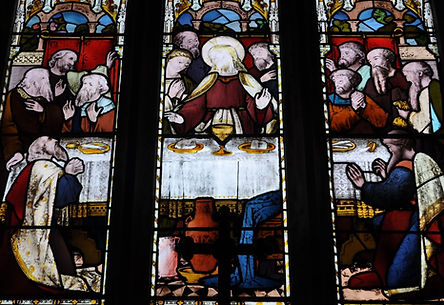
The east window is of five lights and was made by Ward and Hughes in the 1870’s. It features depictions of the Ascension and the Last Supper. In the former the risen Christ is portrayed with wounds visible on hands; rising in to the clouds in front of the remaining 11 disciples. On the latter the supper takes place in front of a symbolically blood red background; with Jesus central and a full consignment of 12 disciples. John, who as always depicted as younger than the others, leans close in to Jesus. Judas is shown far right; staring intently at a bag of money.
To be fair, this window hasn’t aged well since it was made; the informative church guide marking this down to a problem during the production process.


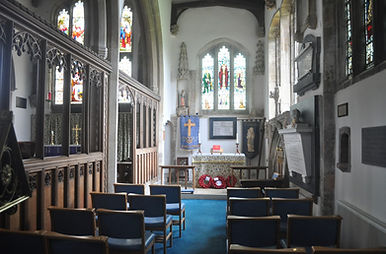
A photograph of the chancel looking east from a previous visit. Note the change in altar cloth, with the purple used during Lent replaced by Green which is the liturgical colour used during 'Ordinary Time'; this being the time in the year which is between the major Christian festivals such as the time between Pentecost and the start of Advent.

The south chapel is of great interest with a Guild of The Blessed Virgin Mary being formed here as far back as 1358. There was also a chantry chapel here with prayers said or chanted. This was noted in a will for one William Strood who in 1498 instructed his executors to sing for his soul and for those that he was ‘Bounden to pray for’; this being in those pre reformation days when the state religion was Catholic, with these prayers said to lessen the time that the soul of the deceased and those that they prayed for had to spend in purgatory.
There is an arcade of two bays against the north wall, which lead in to the chancel, with oak screen across these bays. This chapel also has its east window flanked by niches, with the niche to the north having a modern statue of the Virgin and Child; the niche to the south is empty. Again, there are angels at the foot of these niches, with carvings of great quality.
Curiously there is a door cut in to the wall at the north east corner of the south chapel which leads directly to the high altar in the chancel. A medieval piscina is set against the south wall indicating, as you would expect, that the Mass was given out from this altar.


The east window of the south chapel is of three lights and was made by James Powell & Sons of Whitefriars. This has the Risen Christ central flanked by St Michael and Mary the Mother of Jesus. Christ is crowned with arms raised and wounds visible on hands and feet. He wears a symbolically blood red cloak upon which are gilded depictions of Adam and Eve and the serpent wrapped around the Tree of the Knowledge of Good and Evil.
St Michael holds the scales upon which souls will be weighed on the day of judgement, Mary, dressed in her traditional blue which also has gilded scenes on it, including a depiction of Madonna and child; holds lilies as a symbol of purity and points upwards towards Heaven.
Other glass in the south chapel is a fine, if Biblically inaccurate, depiction of the nativity. This fine five light window shows the shepherds and the wise men all together at the same time; installed in memory of Catherine the wife of John Sherwin Gregory of Harlaxton Manor. He died in 1869 with Catherine holding the estate of Harlaxton until she died in 1892.


Moving back in to the nave, a stained glass panel in the south aisle shows the baptism of Jesus, another window from Powell. Still in the south aisle we have a three light window by Cox & Sons of London. This shows Christ crucified central, depicted in front of a symbolically blood red aureole. Mary the mother of Jesus and John are alongside the cross, with Mary always on the left hand side of the cross as we look at it; on Christ’s right hand, the place of honour in Jewish custom.
A floor slab can be seen in memorial to Hugo Naish, who was Rector here between 1661 and 1676. The text in Latin reads ‘IN SPE CERTA RESURRECTIONIS’, in the certain hope of the resurrection.
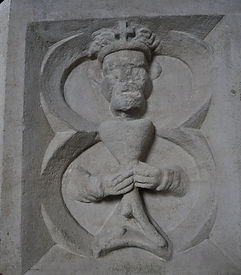
The font is ancient, dating from around 1400; octagonal in design and richly carved on both the bowl and stem. There are some curious carvings as well; some you would expect to see such as a figure raising a chalice during Eucharist but others appear out of place on a parish font to be honest. On the bowl we see a figure wielding a spear and several grotesquely contorted heads; the carvings on the stem are likewise not what we would have expected to normally see. The true meaning is obviously lost in the midst of time!




The church grounds here are very interesting and there are several groups of gravestones and tombs which each have their own Grade II Listing. There are several finely carved slate gravestones in the grounds here; with several pointing out that you will follow in the footsteps of the deceased! One of these features a carving of Old Father Time, carrying a scythe and hour glass, with a depiction of a human skull alongside. He stands on a plinth on which is written ’Prepare to meet thy God’. Close by we see similar; a skull with crossed bones with scripts which reads ‘Reader pause awhile and reflect upon mortality’.
A pattern is starting to form; with Old Father Time making a further appearance, holding again the scythe but this time a scroll as well upon which is written ‘Time flies, glory fades and death’s at hand’. Standing alongside Old Father Time is a skeleton which is holding a shovel and an arrow or dart. The shovel is one of the gravedigger’s tools and is a symbol of mortality. The arrow/dart is another symbol of death but one that is used to signify sudden, unexpected death.
There is a lovely example of this at Teigh in Rutland, around 15 miles away to the south. Here we see carved in slate a woman going about her daily chores; death in the form of a skeleton peers from around a curtain just about to throw an arrow at her.
Throughout the grounds here we see reminders to the onlooker that Man is mortal and will die, and to remember that always. Trust in God, live a good Christian life and do not be caught short when your own time comes; and it days when life expectancy was in the 40’s, it could be later than you think!


It was good to visit here again; this is a church that I am very fond of, in an area that I am also fond of. It was time to move on; heading the short distance west to neighbouring Denton and then on to Woolsthorpe and then Claypole, with all of these churches being open to visitors and all of which are featured on this site.
Open and welcoming, and full of interest, the church of St Mary and St Peter at Harlaxton is well worth taking a look at if you are in the area.